Reviews drive off-page SEO by providing third-party validation, keyword signals, and trust indicators that improve local rankings and visibility.
Key takeaways:
- Reviews act as unbiased verification for search engines.
- Customer feedback adds keyword and location relevance.
- Review velocity signals active and reliable businesses.
- Multi-platform reviews strengthen authority and consistency.
- Sentiment analysis impacts trust and ranking potential.
- Responding to reviews improves engagement and credibility.
Consistent, high-quality reviews build authority, strengthen trust signals, and help contractors rank higher in local search results.

In the modern search environment, the technical distinction between “On-Page” and “Off-Page” SEO has blurred. While on-page SEO involves the content and code on your own website, off-page SEO is essentially the “Digital Footprint” your business leaves across the rest of the internet. For contractors, the core of this footprint is the customer review. In 2026, search engines do not just look at reviews as a conversion tool for humans; they use them as a primary data source to verify the location, service quality, and legitimacy of your business entity.
When a homeowner leaves a review on Google, Yelp, or a trade-specific site, they are providing search engines with “Unbiased Verification.” This third-party data is weighted more heavily than anything you write on your own website. For a local contractor, a robust and active review profile is the single most important factor for ranking in the Local Map Pack. If your off-page reputation is stagnant or negative, your on-page SEO efforts will struggle to gain traction.
The Role of Semantic Keywords in Customer Feedback
One of the most overlooked aspects of off-page SEO is the “Semantic Content” within the reviews themselves. In 2026, search algorithms use natural-language processing to read and understand the text of your reviews. When a customer writes, “They did a great job installing my tankless water heater in [City],” they are providing a powerful localized-keyword signal that you cannot replicate yourself.
These “User-Generated Keywords” help the search engine associate your business with specific services and locations. If twenty different customers mention “emergency roof repair” in their reviews, the algorithm gains a high degree of confidence that you are a top-tier provider for that specific service. This is why you often see businesses ranking in the Map Pack for terms that do not even appear on their homepage. The off-page signals provided by your customers are essentially “Voting” for your relevance in specific search queries.
Review Velocity and Business Vitality
Search engines prioritize “Active Entities.” In the home-services sector, this is measured through “Review Velocity,” which is the frequency and consistency at which you receive new feedback. A contractor who has five hundred reviews but hasn’t received a new one in six months is viewed as a “Stale Entity.” The algorithm may assume the business has closed, moved, or lowered its standards.
Maintaining a steady stream of new reviews tells the search engine that you are currently active and performing work in the community. This “Recency Signal” is a major ranking factor for the Map Pack. A business with fewer total reviews but higher recent velocity will often outrank a legacy competitor with a massive but stagnant profile. To win at off-page SEO, you must implement a system that asks for feedback at the completion of every job, ensuring your “Digital Pulse” remains strong in the eyes of the algorithm.
Diversification Across Third-Party Platforms
While Google Business Profile is the primary target for most contractors, off-page SEO requires “Platform Diversification.” Search engines look for “Consensus” across the web. If you have five stars on Google but no presence on Yelp, Angi, or the Better Business Bureau, the algorithm sees a “Consistency Gap.”
In 2026, search engines crawl specialized trade directories and local community sites to see if your “Business Entity” is recognized elsewhere. Having a consistent profile across multiple high-authority platforms reinforces your legitimacy. This “Citation Consistency” ensures that your name, address, and phone number are synchronized everywhere. When the search engine finds the same positive sentiment mirrored across different platforms, it solidifies your “Authority Score,” making you a safer choice to recommend to users.
Sentiment Analysis and Trust Scores
Modern search engines perform deep “Sentiment Analysis” on your off-page feedback. They are looking for more than just a star rating. They look for specific “Trust Attributes” such as punctuality, cleanliness, and fair pricing. If the majority of your reviews mention that you were “on time” and “cleaned up the job site,” the algorithm categories you as a high-quality service provider.
This sentiment directly impacts your “Trust Score,” which is an invisible metric that determines how often you appear in “Low-Risk” search queries. For high-ticket construction projects, the algorithm is more likely to recommend a firm with a high sentiment score for “Professionalism” and “Integrity.” Off-page SEO is essentially a digital version of “Word-of-Mouth” marketing, and the search engine acts as the listener who decides which rumors are worth believing.
The Interaction Factor: Why Replying Matters
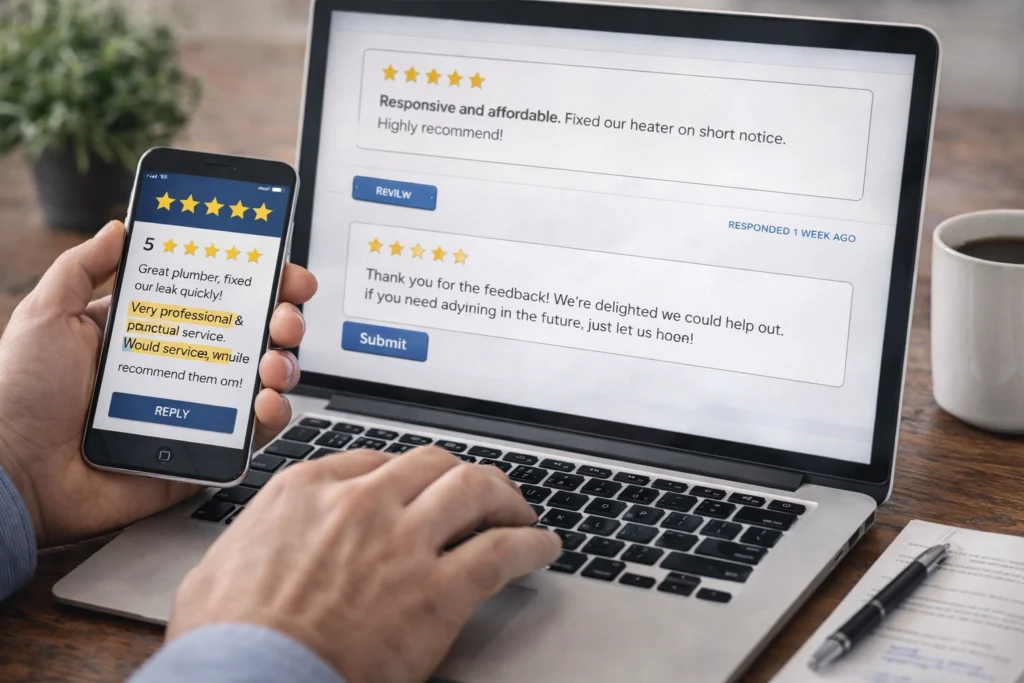
Off-page SEO is not a one-way street. The way you interact with your reviews is a significant signal of business health. In 2026, the algorithm tracks your “Response Rate” and “Response Time.” A contractor who responds to every review, both positive and negative, is seen as a highly engaged and customer-centric business.
Replying to reviews also allows you to naturally include additional “Contextual Keywords.” For example, responding to a positive review with, “Thank you for the opportunity to help with your kitchen remodel in [Neighborhood],” adds another layer of geographic and service relevance to your profile. Furthermore, the way you handle negative reviews provides a “Stability Signal.” A professional, calm response to a complaint shows the search engine that you are a responsible entity that takes accountability. This reduces the “Risk Profile” of your business in the eyes of the algorithm.
Conclusion
Reviews are the “Fuel” for your off-page SEO engine. In 2026, you cannot expect to dominate the local search results through technical website optimization alone. You must build a “Reputation Ecosystem” that proves your value through the voices of your customers. By focusing on review velocity, semantic depth, and platform diversification, you create a dominant digital presence that search engines feel confident recommending. Your off-page reputation is the “Proof of Life” for your business. When your digital footprint is defined by a consistent stream of high-quality, localized feedback, you create a competitive advantage that is nearly impossible for a competitor to overcome through traditional SEO alone.