A construction website can rank well but still fail to generate calls when traffic does not match buyer intent or the site creates friction. Weak CTAs, poor mobile experience, slow interaction speed, and missing trust signals can cause visitors to leave before contacting you.
Key takeaways:
- Ranking does not guarantee phone calls or leads.
- Search intent must match the service page goal.
- Mobile friction can quickly lose high-intent visitors.
- Trust signals help homeowners feel safe reaching out.
- Clear, visible CTAs improve conversion rates.
- Slow site interactions weaken confidence and usability.
- Local proof helps turn visibility into real inquiries.
When construction websites align ranking visibility with buyer intent, mobile usability, trust signals, and strong calls to action, more visitors feel confident enough to call.

It is a frustrating scenario for many business owners: your website appears on the first page of Google, your traffic numbers are climbing, yet your dispatch board remains empty. In the competitive 2026 home-services market, ranking is only half the battle. If your website is visible but not converting, you are likely suffering from a lack of alignment between what the user expects and what your site provides. High-value leads are not just looking for a name; they are looking for a reason to choose you over the three other contractors appearing in the search results.
When a website ranks but fails to generate calls, it usually points to a breakdown in the lead-generation funnel. This could be due to technical friction, a lack of trust-building content, or a fundamental misunderstanding of searcher intent. To turn your traffic into revenue, you must identify and eliminate the silent killers that are causing potential clients to bounce before they ever hit the contact button.
The Disconnect Between Search Intent and Content
One of the most common reasons for a high-ranking, low-converting site is “Intent Mismatch.” You may be ranking for broad, educational terms that attract researchers rather than buyers. For example, if you rank number one for “how to tell if a roof is leaking,” you will get plenty of traffic from people trying to diagnose their own problems. However, these users may not be ready to hire a professional yet.
To drive calls, you must prioritize “Commercial-Intent” keywords. These are phrases like “emergency roof repair,” “certified roofing contractor,” or “roof replacement quotes.” If your high-ranking pages are purely educational and lack a clear, urgent path to a service call, users will consume your free information and then leave to find a contractor who seems more ready to do the physical work.
Friction Points in the Mobile User Experience
In 2026, over 80 percent of local home-service searches occur on mobile devices. If your website ranks well on desktop but provides a clunky, difficult experience on a smartphone, you will lose the lead instantly. Common friction points include tiny buttons that are hard to press, intrusive popups that block the screen, and slow-loading images.
A major culprit is the lack of a “Click-to-Call” button. A homeowner in a crisis does not want to hunt for your phone number, memorize it, and then switch to their keypad. They want a prominent, “thumb-friendly” button that initiates the call in one tap. If your phone number is buried in a tiny “Contact” menu or is not a clickable link, you are creating unnecessary work for the user. In a zero-friction world, even a three-second delay in finding a phone number can result in a lost lead.
The “Trust Deficit” and Lack of Social Proof
Ranking proves that Google trusts you, but it does not prove that a homeowner should. High-value projects require a high level of digital trust. If your website looks like a generic template with stock photos and vague promises, you are failing to build a connection with the lead.
To convert traffic into calls, you must display “Trust Signals” prominently. This includes recent, high-resolution photos of your branded trucks, your team in uniform, and your completed projects. Verified reviews from local neighborhoods and logos of industry certifications act as the “Digital Handshake” that confirms your legitimacy. If a user lands on your site and sees a faceless corporation instead of a local expert, they will likely return to the search results to find a firm that feels more accountable.
Weak or Hidden Calls to Action
A surprising number of construction websites fail to actually ask for the business. Your call-to-action (CTA) should be the most visible element on the page. If your primary goal is to get phone calls, your phone number should be in the header, the footer, and multiple times within the body of the page.
Beyond just visibility, the language of your CTA matters. Generic phrases like “Contact Us” or “Submit” are uninspiring. Instead, use “Urgency-Driven” CTAs such as “Get a Same-Day Quote,” “Schedule Your Emergency Repair,” or “Talk to a Licensed Electrician Now.” By telling the user exactly what to do and what benefit they will receive, you reduce the “Decision Fatigue” that often leads to a bounce.
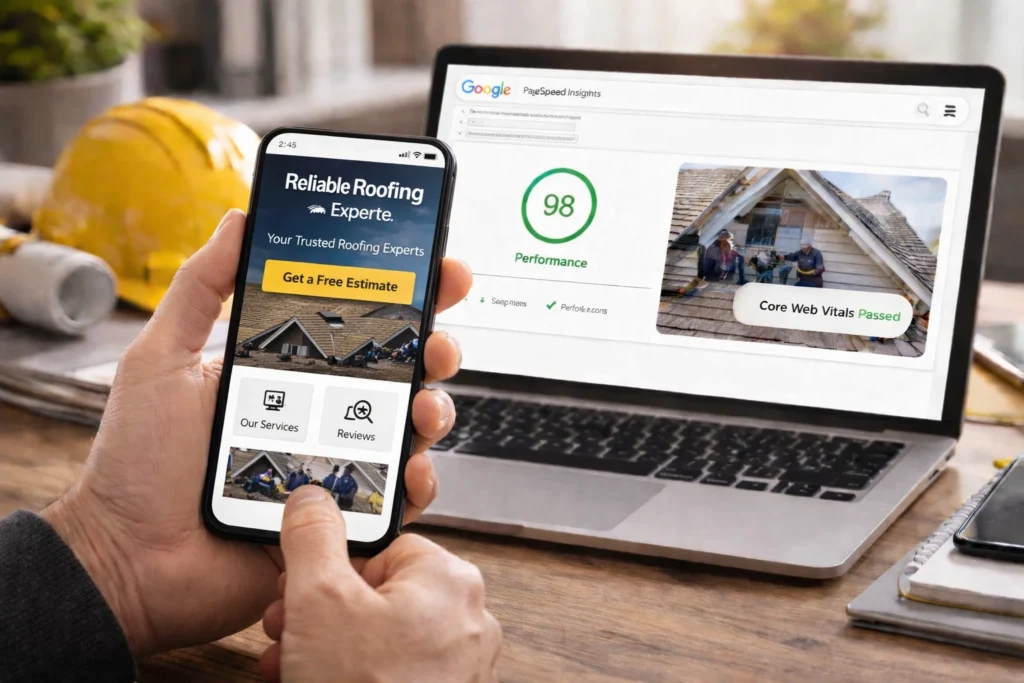
Slow Interaction Speeds and Performance Issues
In the 2026 SEO environment, the “Interaction to Next Paint” (INP) metric is a silent conversion killer. This measures how fast your site reacts when a user tries to engage with it. If a lead clicks on your “Request a Quote” form and there is a noticeable lag before the form appears, they may perceive your business as disorganized or unprofessional.
Technical performance is a reflection of your physical service. A fast, responsive website suggests a fast, responsive contractor. If your site feels sluggish, the user subconsciously assumes that your communication and project management will be sluggish as well. Optimizing your site’s technical infrastructure is not just for the search engines; it is for the user who is looking for a reason to trust you with their home.
The Absence of “Localized Authority”
Even if you rank for a city-wide term, a lead in a specific suburb wants to know that you work in their neighborhood. If your website feels too broad or “national,” you lose the local advantage. You must prove your local presence through neighborhood-level content and local landmarks.
Mentioning specific local building codes, regional weather challenges, or recent projects completed on well-known streets helps bridge the “Locality Gap.” When a homeowner sees that you have successfully completed a project three blocks away from them, the perceived risk of hiring you drops significantly. This hyper-local authority is often the final nudge a user needs to stop searching and start calling.
Conclusion
Ranking on the first page is an invitation to the dance, but your website’s content and design are what actually close the deal. By aligning your content with buyer intent, eliminating mobile friction, and saturating your pages with authentic trust signals, you can turn a high-ranking site into a lead-generating machine. In 2026, the contractors who win the most calls are the ones who make it incredibly easy and emotionally safe for the user to reach out. Stop focusing purely on traffic and start focusing on the “Digital Path” your leads take from the search result to the phone call.