Algorithm updates now prioritize entity trust, local authority, and technical performance over outdated SEO tactics. Contractors must maintain accurate data, strong reviews, and helpful content to protect rankings.
Key takeaways:
- Google prioritizes verified business entities
- Helpful content updates target thin local pages
- Core Web Vitals affect contractor rankings
- Local relevance influences map pack visibility
- Review authenticity impacts GBP trust signals
- Geo-tagged project proof supports service area rankings
- Technical consistency strengthens update resilience
Contractors who focus on trustworthy content, local authority, and technical SEO build stronger rankings that remain stable through future algorithm updates.
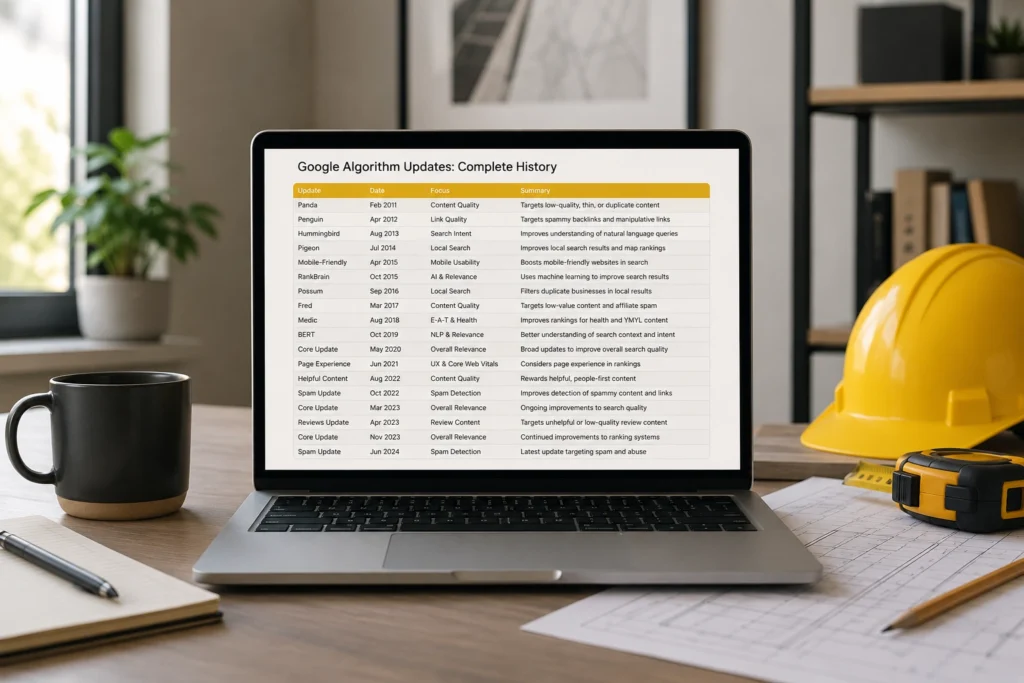
For the modern contractor, a Google algorithm update can feel like a sudden storm that threatens to wipe out months of progress. In the high-stakes world of home services, where a top-three ranking in the Map Pack can generate hundreds of thousands of dollars in annual revenue, these shifts are more than just technical adjustments. They are fundamental changes in how the digital economy decides which plumber, electrician, or roofer is worthy of a homeowner’s trust. In 2026, these updates have become increasingly focused on “Entity Authentication,” which means the algorithm is now capable of distinguishing between a real, local business and a “ghost” operation designed solely for lead generation.
Understanding how these updates function is the key to building a “Resilient Digital Infrastructure.” Gone are the days when a contractor could “fix” their SEO after a drop. Today, you must build a website and a Google Business Profile (GBP) that are “Update-Proof.” This requires moving away from short-term hacks and toward a strategy that prioritizes technical accuracy, verified data, and genuine local authority.
The Shift from Keywords to Entity Confidence
In previous years, algorithm updates often targeted specific “Spam Tactics” like keyword stuffing or low-quality backlink building. In 2026, the focus has shifted to “Entity Confidence.” Google now uses its Knowledge Graph to cross-reference every piece of data about your business. It looks at your business license, your social media activity, your local citations, and even your video-verification data.
When an update occurs, the algorithm is often recalculating the “Trust Score” of every business in a specific trade. If there is a mismatch between your website and your GBP, or if your “Proof of Work” photos do not match your claimed service area, your rankings will plummet. To survive these updates, you must maintain a “Single Source of Truth.” Every digital mention of your business must be consistent, verified, and technically accurate.
The Impact of Helpful Content Updates on Local Trades
Google’s “Helpful Content” system is now a core part of the daily algorithm. In 2026, this system is specifically designed to demote “Thin Content” that was written solely for search engines. Many contractors make the mistake of using AI to churn out hundreds of generic city pages that all say the same thing. This is now a major liability.
When a Helpful Content Update is released, sites with “Low Information Gain” are the first to be penalized. To protect your business, your content must provide actual value. This means including specific details like “how to prepare for a winter freeze in North Dallas” or “the specific permit requirements for deck building in Austin.” By providing this hyper-local, technical knowledge, you signal to the algorithm that you are a “Subject Matter Expert.” This expertise acts as a shield during major updates, as Google will always prioritize the “Most Helpful” source for the user.
Core Web Vitals and the Interaction to Next Paint (INP)
In 2026, technical performance is no longer a “bonus” ranking factor; it is a requirement. Major updates now place a heavy emphasis on “Core Web Vitals,” specifically the “Interaction to Next Paint” (INP) metric. This measures how quickly your site responds when a user clicks a button or opens a menu.
For a contractor, a slow site is a sign of a low-quality business. If an update rolls out and your site speed is below the industry average, you will likely see a significant drop in mobile rankings. Homeowners in a crisis, such as a burst pipe or a broken AC, do not have the patience for a lagging website. Google knows this, and its algorithm updates are increasingly designed to favor “Frictionless Experiences.” Investing in a high-performance, mobile-first website is one of the best ways to ensure your rankings remain stable during technical updates.
Proximity and the “Relevance Radius”
A frequent feature of recent algorithm updates is the adjustment of the “Proximity Filter.” Google is constantly fine-tuning how far a business can rank from its physical location. In 2026, these updates often target “Service Area Businesses” (SABs) that claim excessively large territories without having a physical presence in those areas.
If an update hits and you see your rankings drop in cities thirty miles away, it is likely because Google has tightened its “Relevance Radius.” To combat this, you must prove your activity in those outlying areas. This is done by uploading geo-tagged project photos and collecting reviews from customers in those specific zip codes. By providing “Digital Footprints” of your work, you prove to the algorithm that you are truly a local provider, regardless of how the proximity filter is adjusted.
Sentiment Analysis and Review Authenticity Updates
Review spam has been a major target for algorithm updates in 2026. Google’s AI is now incredibly proficient at “Sentiment Analysis.” It can detect the difference between a genuine, detailed review from a local customer and a “bought” review from a click farm.
During a “Spam Update,” businesses that have relied on fake or low-quality reviews will see their entire GBP suspended or suppressed. To avoid this, you must focus on “Deep Social Proof.” Encourage your customers to write detailed accounts of their experience and to upload their own photos of the completed work. These “User-Generated Signals” are the most difficult to fake and the most respected by the algorithm. Authentic, high-quality reviews are the ultimate insurance policy against reputation-based updates.
Video Verification and Manual Review Triggers
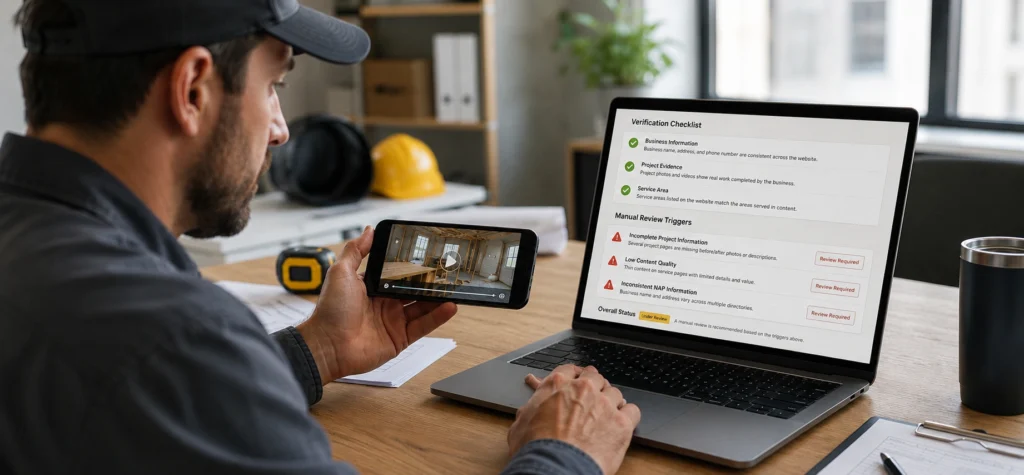
In 2026, many algorithm updates trigger “Manual Review” requests for businesses in high-risk categories like plumbing, roofing, and locksmithing. If your profile is flagged during an update, you may be required to complete a “Video Verification” to prove your legitimacy.
Contractors who are unprepared for this often lose their rankings for weeks while they scramble to gather the necessary proof. To be update-ready, you should always have your “Verification Assets” ready: a branded vehicle, your professional tools, and your business licenses. Being able to quickly prove your “Physical Reality” is a competitive advantage in a digital world where “Fake Entities” are constantly being purged by new algorithm updates.
Conclusion
Algorithm updates are not a threat to businesses that are built on a foundation of genuine authority and technical excellence. In 2026, the goal of every update is the same: to provide the user with the most reliable, local, and helpful expert available. By focusing on entity confidence, hyper-local helpfulness, and elite technical performance, you can turn these updates into an opportunity. While your competitors are panicking and trying to “hack” their way back to the top, your business will remain a stable, trusted fixture in the local search results.