Contractor SEO vs Google Ads isn’t really a choice about which one works. It’s a choice about timeline: Google Ads can produce a qualified call within 48 hours of launching, while SEO typically needs 3 to 6 months before it shows real movement. Contractors with an immediate need for leads usually start with Google Ads, while ones with some runway and a longer view usually start with SEO, and most established contractors eventually run both.
The right first move depends less on which channel is objectively better and more on which problem is more urgent right now.
Key Takeaways
- Google Ads can generate a qualified call within 48 hours of launching, while SEO typically takes 3 to 6 months to show meaningful movement.
- Organic leads average roughly $35 each compared to about $135 for paid leads, though Google Ads still wins on speed.
- A common starting split for contractors is 60 to 70 percent PPC and 30 to 40 percent SEO in the first 3 to 6 months, shifting toward SEO as it matures.
- SEO tends to deliver a higher long-term return, often cited around 400 percent, compared to roughly 250 to 300 percent for PPC.
- Paid ads can still capture up to a third of clicks on a search where a business doesn’t rank organically at all, which is why PPC often fills the gap while SEO builds.
- Most established contractors eventually run both, using PPC for immediate volume and SEO as the channel that keeps working without ongoing spend.
For the fuller picture of how organic search works for contractors overall, see our contractor SEO strategy guide. This piece focuses specifically on how SEO stacks up against Google Ads and which one deserves budget first.
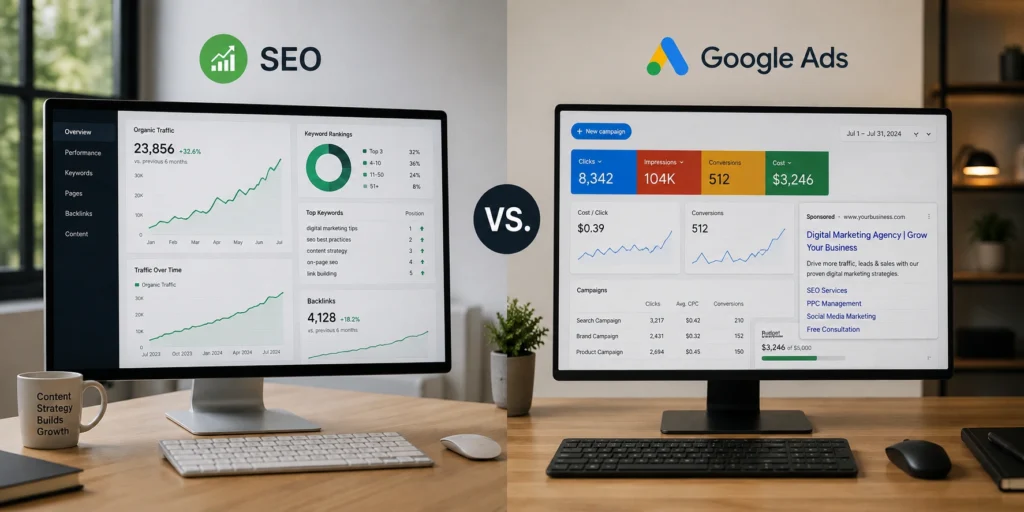
Why This Isn’t Really an Either-Or Decision
Contractors often frame contractor SEO vs Google Ads as a single decision between two competing options, but the more useful framing is timeline: what’s needed right now versus what’s being built for the next few years. Google Ads and SEO solve different problems, and most contractors who succeed with digital marketing eventually use both, just not necessarily at the same time or in the same proportions.
Treating the decision as permanent is where most contractors go wrong. The right channel to prioritize this quarter isn’t necessarily the right one to prioritize next year, and the businesses that get the most value from both treat the split as something to actively manage, not a one-time choice.
Consider a roofer opening a second location in a new city. In that new market, SEO has zero history to build on, no local citations, no reviews tied to that address, no rankings at all, while Google Ads can put the business in front of storm-damage searches the same week the location opens. Six months later, once local citations, reviews, and a handful of location-specific pages have had time to take hold, the calculation shifts, and SEO starts carrying weight it couldn’t have carried on day one.
Cost and Speed: How SEO and Google Ads Actually Compare
The clearest way to compare the two channels is side by side, since the tradeoffs run in opposite directions on nearly every dimension that matters.
| Category | SEO | Google Ads |
| Time to First Results | 3 to 6 months for meaningful movement | Can generate a qualified call within 48 hours |
| Average Cost Per Lead | Roughly $35 | Roughly $135 |
| Typical Long-Term ROI | Often cited around 400 to 450 percent | Often cited around 250 to 300 percent |
| When You Stop Paying | Rankings and traffic continue, though they may fade gradually | Leads stop almost immediately |
| Best For | Building long-term, lower-cost lead volume | Immediate leads, testing new keywords or services |
| Recommended Starting Split (first 3-6 months) | 30 to 40 percent of budget | 60 to 70 percent of budget |
Neither column is the objectively better choice. A contractor who needs the phone ringing this month and one who’s planning three years out are solving different problems, and the right channel depends entirely on which problem is more urgent.
What Determines Which One You Should Start With
When to Start With Google Ads
Google Ads makes sense first when leads are needed immediately: a slow month, a new service area with zero existing visibility, or a new service line worth testing before committing months of content production to it. It’s also the more straightforward choice for highly seasonal trades that need visibility the moment demand spikes, since there’s no ramp-up period to wait through.
When to Start With SEO
Contractor search optimization makes more sense first for contractors with some runway, meaning the business can function for a few months without an immediate lead surge, and a longer view on where the business is headed. It’s also the stronger first move in highly competitive, high-cost-per-click trades, where the price of paid clicks can erode margin quickly enough that organic visibility becomes the only sustainable long-term option.
An established contractor with steady referral work and no urgent gap to fill is often in the best position to start with SEO, precisely because there’s no pressure forcing a faster, more expensive channel. That patience is a genuine advantage: SEO rewards contractors who can wait for compounding results, and penalizes ones who need to see returns before the foundational work has had time to take hold.
Testing Keywords with PPC Before Committing to SEO
One of the most useful ways to combine both channels doesn’t involve running them side by side forever. It involves using Google Ads as a fast, cheap research tool before committing to a long-term SEO investment. Running paid ads against five or ten keyword variations for a few weeks reveals which searches actually turn into booked jobs, not just clicks.
Contractor keyword research built on that real conversion data, rather than guesses or generic keyword tools, gives SEO content a real head start, since it’s targeting terms already proven to convert instead of terms that simply have decent search volume.
A kitchen remodeling company might assume “kitchen remodel cost” is worth chasing organically, only to discover through a short PPC test that it drives mostly research traffic with a low conversion rate, while a less obvious term like “kitchen remodel contractor near me” converts at several times that rate. Spending months building SEO content around the wrong assumption is a far more expensive mistake than the few hundred dollars it costs to test both terms with paid ads first.
Running Both Together: The Long-Term Play
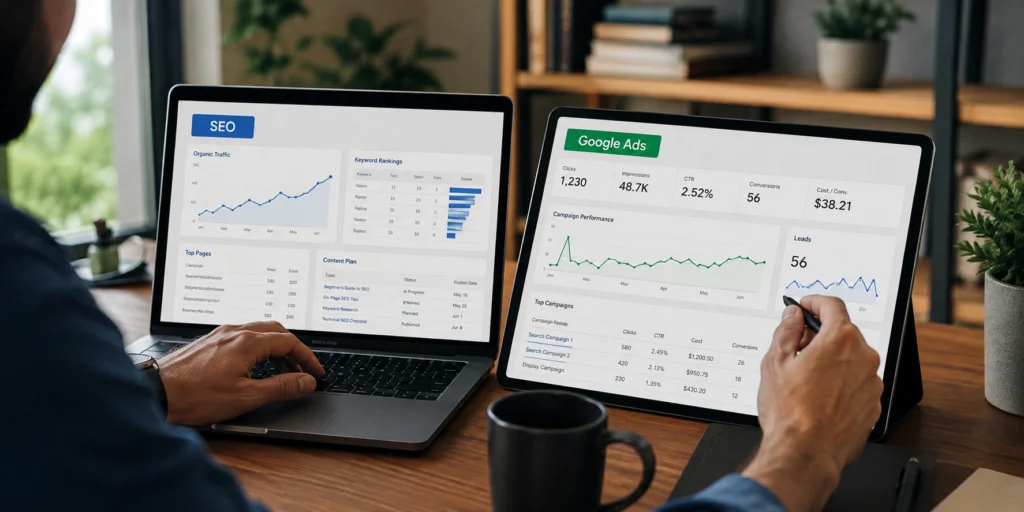
Most contractors who use both channels well don’t split budget evenly forever. A common pattern starts closer to 60 to 70 percent PPC and 30 to 40 percent SEO in the first three to six months, then shifts toward 40 percent PPC and 60 percent SEO or further as organic rankings mature and start carrying more of the lead volume on their own.
Practical contractor SEO audit work early in that process helps identify exactly which pages and keywords are worth the SEO investment, so budget isn’t spread thin across too many priorities at once.
The businesses that get this wrong usually make one of two mistakes: cutting PPC entirely the moment SEO shows early signs of life, before it’s actually replaced that lead volume, or never shifting budget toward SEO at all, paying for the same clicks indefinitely instead of letting a growing asset take over some of that cost.
A practical way to manage the transition is tracking lead volume by source monthly, not just checking in occasionally. When organic leads start covering a meaningful share of what PPC used to carry alone, that’s the signal to shift budget, not a fixed date on a calendar. Markets and trades mature at different rates, and a rigid month-six cutover ignores what the actual numbers are showing.
Things to Know
- Paid ads can still capture a meaningful share of clicks even on searches where a business ranks well organically, since some searchers click the first result regardless of whether it’s paid or organic.
- A new service area with zero existing SEO presence usually needs paid ads to generate any visibility at all in the first few months.
- Google Ads campaigns can be paused and resumed instantly. SEO progress degrades gradually when work stops, which makes it a poor fit for a start-and-stop budget.
- Landing page quality affects both channels, but it affects Google Ads ROI immediately, since a weak page wastes paid clicks the same day they’re purchased.
- Brand searches, people typing a company name directly, tend to increase as SEO matures, a signal that awareness is building even before lead volume rises.
- A technical SEO problem can quietly undermine both channels at once, since a slow or broken site hurts organic rankings and wastes the clicks paid ads are sending to it.
Frequently Asked Questions
Should contractors invest in SEO or Google Ads first?
Contractors who need leads immediately usually start with Google Ads, while those with some runway and a longer-term view usually start with SEO.
Most established contractors eventually run both, using Google Ads for immediate volume and SEO as the channel that keeps working without ongoing spend.
Is SEO cheaper than Google Ads for contractors?
Over time, yes. Organic leads average roughly $35 each compared to about $135 for paid leads, though SEO requires months of investment before it produces that lead volume.
Google Ads has no ramp-up period but keeps costing money for every lead, while SEO costs more upfront in time before it becomes the cheaper channel per lead.
Can Google Ads and SEO work together?
Yes, and running both is usually the strongest long-term approach, with many contractors starting closer to 60 to 70 percent PPC and shifting toward SEO as organic rankings mature.
Google Ads can also double as a research tool, testing which keywords actually convert before committing months of SEO content production to those same terms.
How fast does Google Ads work compared to SEO?
Google Ads can generate a qualified call within 48 hours of launching a campaign, while SEO typically needs 3 to 6 months to show meaningful movement.
That speed comes at a cost: Google Ads stops producing leads the moment spending stops, while SEO continues working, even if it fades gradually, after the investment ends.
What happens to leads if you stop paying for Google Ads?
Leads from Google Ads stop almost immediately once spending stops, since paid placement disappears the moment a campaign is paused.
This is the core tradeoff with SEO: a completed blog post or an earned backlink keeps working long after it’s published, while a paused ad campaign stops generating anything the same day.
Matching the Channel to the Timeline
Contractor SEO vs Google Ads isn’t a question with one right answer, but it is a question with a reliable way to think through it: match the channel to the timeline actually being worked with, not the one that would be more convenient.
Construction Marketing Services builds both SEO and Google Ads campaigns for contractors, and helps decide which one to prioritize first based on budget, trade competitiveness, and how much runway the business actually has. If the current approach feels like guesswork, that decision is worth revisiting before the next budget cycle.