Project pages often convert better than blog content for contractors because they show real proof, local relevance, and completed work. While blogs can educate prospects, project pages help validate trust and move ready-to-hire homeowners closer to a call.
Key takeaways:
- Project pages provide proof, while blogs mainly provide advice
- Homeowners viewing project pages are usually closer to hiring
- Localized project details strengthen geographic relevance
- Unique project stories create stronger information gain
- Generic blog content is less effective for conversions
- Blogs can support project pages through internal links
- Contractors should prioritize project pages when budget or time is limited
When contractors use project pages to showcase real work, local experience, and technical problem-solving, they create stronger conversion assets than generic blog content alone.
As the digital landscape for home services becomes more sophisticated in 2026, contractors must be ruthless with where they spend their marketing energy. For years, the industry was told that blogging was the only way to stay relevant in search. This led to a flood of generic articles that, while helpful for general traffic, rarely resulted in a signed contract. Today, the data is clear: for the local contractor, project pages almost always outperform blog content when it comes to actual conversions.
The reason for this shift lies in the intent of the user. A person reading a blog post is often in the research and education phase. They are looking for ideas, tips, or DIY fixes. However, a person viewing a project page is in the validation and selection phase. They have already decided they need a professional, and they are now vetting you against your competitors. Understanding how to balance these two content types is the key to a website that does not just rank, but actually sells.
The Psychological Impact of Proof over Advice
A blog post offers advice, but a project page offers proof. In a world of AI-generated text and stock photography, homeowners are increasingly skeptical of what they read. They have seen enough generic trends articles to last a lifetime. What they have not seen is how you specifically handled a complex structural issue in a home just like theirs, located three miles away.
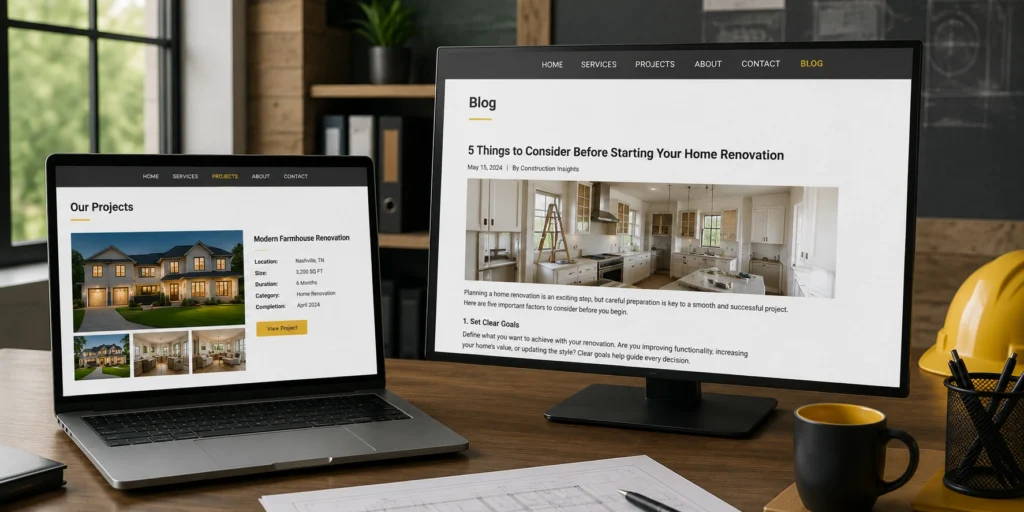
Project pages provide visual and narrative proof of your competence. When a homeowner sees a gallery of a completed job along with a description of the challenges you overcame, it triggers a much stronger trust response than a list of tips. This is because a project page proves you have done the work, while a blog only proves you can write about it. For a contractor, doing is the ultimate currency. This makes project pages the primary driver for high-ticket leads who value results over rhetoric.
Targeting the Bottom of the Funnel
The marketing funnel for a contractor is often shorter than people realize. Most homeowners do not spend six months reading blogs before they hire a plumber or an electrician. They realize they have a problem and they look for a solution. Blog content is typically top-of-funnel, attracting people who might not even live in your service area.
Project pages are bottom-of-funnel assets. They are highly localized and highly specific. When someone searches for a custom deck builder in a specific city, and they land on a page showcasing three decks you built in their neighborhood, the relevance is immediate. There is no need for them to read a blog post about the history of wood decking. They have seen your work, they know you operate in their area, and they are ready to hit the call button.
The Authority Signal of Geographic Relevance
One of the biggest advantages of project pages is their ability to reinforce your local authority. In 2026, search engines and AI assistants prioritize geographic proximity for service-based queries. A blog post about how to maintain a roof is geographically neutral. It could be written by someone in Florida or someone in Seattle.
A project page detailing a roof replacement in a specific historic district is a massive location signal. It tells the search engine that your business is physically active in that area. This hyper-local content is much more valuable for ranking in the map pack than a generic blog. By showing that you are the go-to expert for a specific neighborhood, you build a local moat that national competitors and broad-topic blogs cannot penetrate.
Information Gain and the End of Generic Blogging
Search engines now reward information gain, which is the presence of new, non-derivative information. Most contractor blogs fail this test because they simply rehash what is already on the internet. This is why many blogs have seen their traffic drop in the age of AI.
Project pages are, by definition, full of information gain. Every job site has unique photos, unique challenges, and unique solutions that exist nowhere else on the web. This makes project pages AI-proof. When an AI-search engine looks for the most relevant expert to recommend, it looks for these unique data points. A website with fifty detailed project pages will be seen as a much higher authority than a website with fifty generic blog posts that say the same thing as everyone else.
Balancing the Two for a Complete Strategy
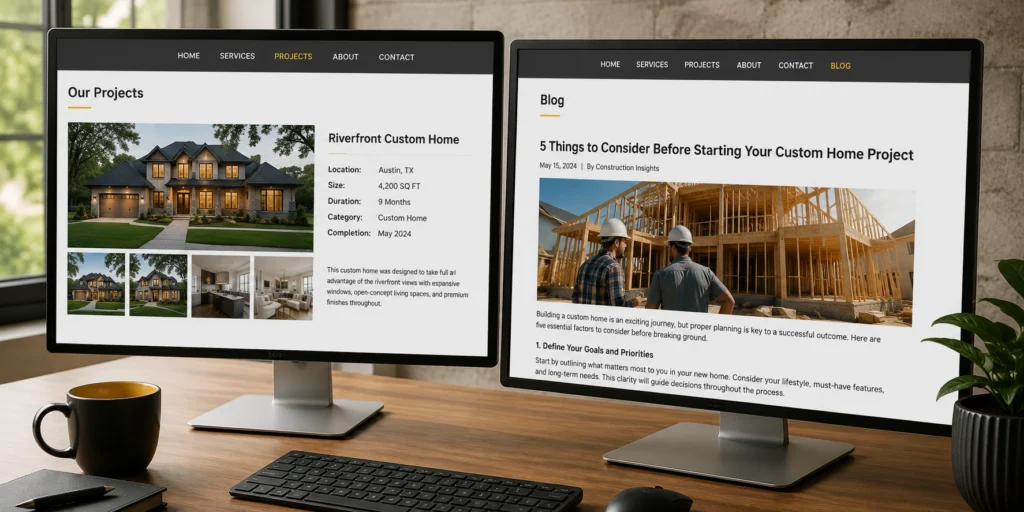
While project pages are the conversion winners, this does not mean you should delete your blog entirely. The blog still has a role to play as a support tool. The most effective strategy is to use the blog to answer why and when questions, while using project pages to answer the how and who.
For example, you might write a blog post about when to replace your windows versus repairing them. Inside that blog post, you should link directly to your project pages that show recent window replacements you have done. This creates a logical bridge for the user. You educate them with the blog and then close the sale with the project page. This synergy ensures that your website is helpful to those in the research phase while being highly effective at capturing those ready to buy.
Conclusion
If you have limited time and budget, prioritize your project pages. In the 2026 marketplace, homeowners want evidence more than information. A website built on a foundation of detailed, localized, and technically deep project stories will always out-convert a website that relies on generic blogging. Project pages are the ultimate lead-generation assets because they provide the geographic relevance and professional proof that modern searchers require. By turning your past successes into digital stories, you create a conversion machine that proves your value before you ever step foot on a client property.