Service categories shape how Google matches home service businesses to local search intent. Choosing the right primary and secondary categories improves visibility, strengthens relevance, and helps contractors appear for the services homeowners are actually searching for.
Key takeaways:
- The primary category carries the most ranking weight.
- Secondary categories expand visibility for related services.
- Service menus should align with selected categories.
- Category relevance matters more than broad or generic labels.
- Seasonal category adjustments can capture changing demand.
- Proper categories improve justification snippets in search.
- New category options can create early ranking advantages.
When contractors align categories, service menus, and seasonal demand, their Google Business Profiles become stronger local ranking assets that attract more qualified leads.

In the competitive world of home services, most contractors focus heavily on their business name and their reviews. While these are vital, there is a technical foundation that often determines whether you even appear in the search results to begin with. These are your Google Business Profile categories. In 2026, these categories act as the primary “intent-matching” mechanism for search engines and AI assistants. If you select the wrong primary category, or if you fail to stack your secondary categories correctly, you are effectively hiding your business from the very homeowners who need your specific expertise.
For a plumber, an electrician, or a remodeler, categories are not just labels. They are the language that search engines use to organize the local marketplace. When a user asks a voice assistant for “water heater repair,” the algorithm does not just look for the word “plumber.” It looks for the entity that has specifically declared “Water Heater Repair” as a core competency through its category and service menu structure.
The Weight of the Primary Category
The most significant ranking signal in your entire local profile is your “Primary Category.” This single selection carries more weight than your business description or your website’s meta-tags. Google uses the primary category to define the “core essence” of your business. If you are a general contractor who specializes in kitchens, but you set your primary category to “Construction Company,” you will likely be outranked by a competitor who chose “Kitchen Remodeler.”
In 2026, the algorithm has become highly specialized. It no longer rewards “generalists” in the same way it rewards “specialists.” To maximize your rankings, your primary category must align with the search terms that drive your highest-value leads. If your business model shifts—for example, if an HVAC firm decides to focus more on “Indoor Air Quality” than “AC Repair”—the primary category must be updated to reflect that shift. A mismatch between your actual work and your primary category creates “entity confusion,” which results in a lower position in the Local Map Pack.
The Strategy of Secondary Category Stacking
While you only get one primary category, Google allows you to select up to nine secondary categories. Many contractors make the mistake of leaving these blank or only choosing one or two. In 2026, “Category Stacking” is a mandatory strategy for regional dominance. Secondary categories allow you to capture “long-tail” searches that your primary category might miss.
For an electrical contractor, the primary category might be “Electrician,” but the secondary categories should include “Lighting Contractor,” “Service Establishment,” and “Electrical Engineer” if applicable. This creates a “web of relevance” around your profile. When a search engine sees a robust stack of related categories, it gains confidence in your topical authority. However, you must avoid “Category Stuffing.” Adding irrelevant categories, such as a plumber adding “Landscaper” just because they dig trenches, can lead to a “relevance penalty” that hurts your primary rankings.
Mapping Categories to the Service Menu
In 2026, the “Service Menu” within your Google Business Profile has become a direct extension of your categories. Simply selecting a category is no longer enough. You must back up each category with specific, described services. If you select “Heating Contractor” as a category, your service menu should include items like “Furnace Installation,” “Boiler Maintenance,” and “Heat Pump Repair.”
Each of these menu items should have a unique description of about 50 to 100 words. Search engines scan these descriptions to understand the “depth” of your service. This is particularly important for AI-driven searches. When a homeowner asks, “Who is the best contractor for high-efficiency heat pump upgrades near me?” the algorithm looks for the business that has the most detailed, category-aligned service description. This technical alignment is what separates the top three results from the rest of the pack.
The Impact of Seasonality on Category Optimization
One of the most effective “pro-tips” for contractors in 2026 is seasonal category adjustment. Home service needs change with the weather, and your profile should reflect those changes. An HVAC contractor should consider switching their primary category from “Air Conditioning Contractor” in the summer to “Heating Contractor” in the winter.
While this may seem like a small change, it aligns your profile with the immediate “search intent” of the local population. When thousands of people suddenly search for furnace repair during a cold snap, Google prioritizes the businesses that have declared heating as their primary focus. By staying ahead of the seasonal curve, you can capture the “surge” in local demand and maintain a steady flow of leads throughout the year.
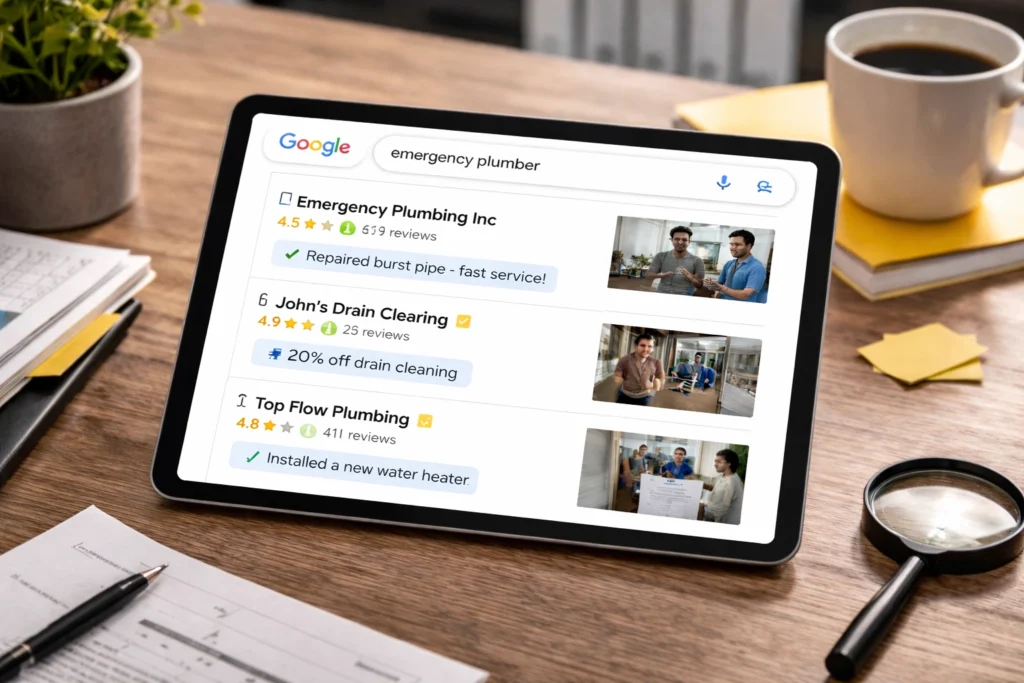
Category Influence on “Justifications” in Search
Have you ever noticed small snippets of text in the search results that say “Provides: Emergency Plumbing” or “Services: Deck Construction”? These are called “Justifications.” They are Google’s way of telling the user exactly why this specific business was chosen for the search result. These justifications are pulled directly from your category and service menu data.
If your categories are properly optimized, you increase the chances of these “relevance snippets” appearing on your listing. This significantly boosts your click-through rate. A user is far more likely to click on a contractor whose listing explicitly states that they provide the exact service being searched for. This “visual confirmation” is a powerful psychological trigger that turns a searcher into a lead.
Monitoring Category Trends and New Additions
Google frequently updates its list of available categories to reflect changes in the industry and consumer behavior. In 2026, new categories related to “Green Energy,” “Smart Home Integration,” and “Electric Vehicle Charging” have become highly competitive.
Contractors who are the first to adopt these new, relevant categories often see a “first-mover advantage” in the rankings. You should audit your category list at least once a quarter to see if new, more specific options have become available. Staying at the forefront of these technical updates ensures that your business remains visible as homeowner needs evolve toward newer technologies and service models.
Conclusion: Mastering the Taxonomy of Local Search
Service categories are the “DNA” of your local search presence. They tell the algorithm who you are, what you do, and where you belong in the competitive landscape. By mastering the art of category stacking, aligning your service menu, and staying responsive to seasonal trends, you create a profile that is perfectly tuned for the search environment of 2026. For the modern contractor, this technical precision is the key to moving beyond generic visibility and into a position of undisputed local authority.