Optimizing Google Business Profiles helps contractors improve local visibility, build trust, and generate more leads through activity, reviews, and service-area signals.
Key takeaways:
- Service-area setup improves local ranking accuracy.
- Category stacking increases visibility for multiple services.
- Geo-tagged photos verify real job locations.
- Reviews strengthen trust and keyword relevance.
- GBP posts boost visibility for niche searches.
Contractors who actively manage GBP with consistent updates, reviews, and local signals gain higher rankings, stronger visibility, and more qualified inquiries.

For a residential or commercial contractor, the Google Business Profile (GBP) is no longer just a digital business card. In 2026, it serves as the primary data source for local search algorithms and AI answer engines. While retail storefronts have it easy, service-based contractors face unique challenges. You likely operate from a warehouse or a home office and perform your work at the customer’s location. This distinction requires a specific optimization strategy that prioritizes geographic trust and service-area verification over foot traffic.
If your profile is not configured to highlight your mobile nature, you risk being filtered out of searches in the very neighborhoods where your trucks are currently parked. Success in the modern local landscape requires a shift from static information to active, location-verified proof of service.
The Service-Area Business (SAB) Configuration
The most critical technical step for a contractor is correctly defining the Service Area Business status. In 2026, Google has become much stricter about address transparency. If you do not have a physical storefront with permanent signage and staffed hours, you must hide your address to remain compliant with Google’s terms of service.
Instead of a pinned location, you define a service area by city, zip code, or a specific radius. However, a common mistake is selecting an area that is too broad. Contractors who claim an entire state often see their rankings diluted across the board. The most effective strategy is to define a core service area within a 20 to 30 mile radius of your base of operations. This concentrated geographic signal allows you to build a “proximity anchor” that search engines view as highly reliable.
Category Stacking and Service Menus
In the 2026 version of the Business Profile, categories act as the primary map for AI intent matching. While your primary category should be your most profitable trade, such as Roofing Contractor or Electrician, your secondary categories provide the necessary context for long-tail searches.
You should utilize all available secondary category slots to cover the full spectrum of your work. For a remodeling contractor, this might include Kitchen Remodeler, Bathroom Remodeler, and General Contractor. Once these categories are set, you must populate the Service Menu with detailed descriptions. Avoid simple lists. Instead, write short, 100-word descriptions for each service that include technical terms and common customer pain points. This structured data is exactly what AI models scan when a user asks for a specific solution like “emergency circuit breaker replacement.”
Verification Through Geo-Tagged Project Photos
Search engines now use computer-vision technology to analyze the content and metadata of your uploaded photos. For a service-based contractor, this is a powerful tool for ranking in specific suburbs. When you finish a job in a neighboring town, take a high-quality photo and upload it directly from that location using the GBP mobile app.
The metadata attached to that photo, known as EXIF data, contains geographic coordinates. While Google may strip this data for public viewing, the algorithm still reads it to verify that your business actually operates in that town. In 2026, a profile with 50 photos from 50 different job sites will consistently outrank a profile with 100 photos taken at the office. This “proof of work” is the modern equivalent of a physical storefront.
Managing Local Reputation and Sentiment
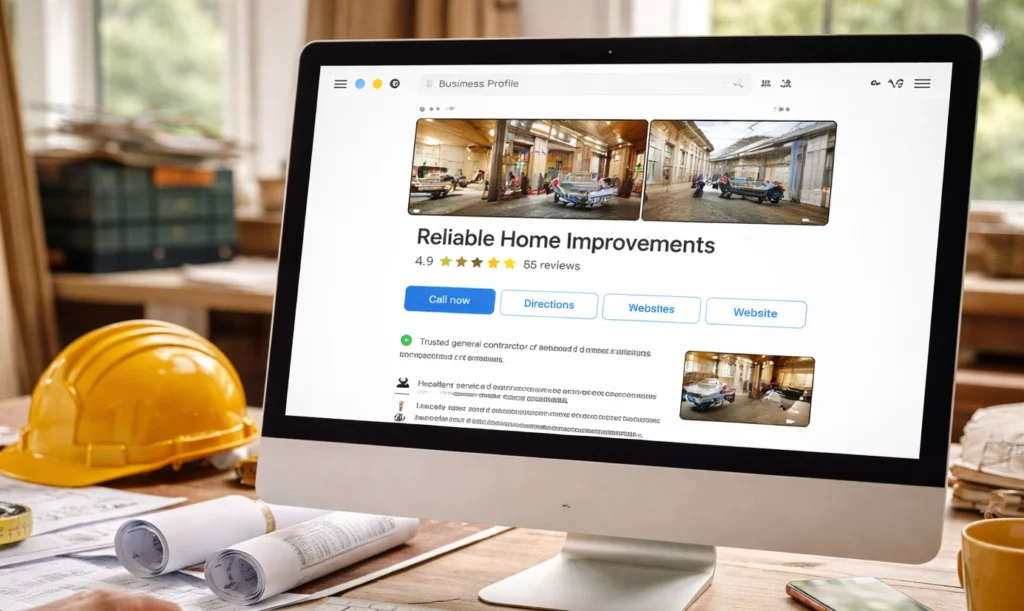
Reviews have evolved beyond a simple star rating. Google now analyzes “sentiment depth,” which looks at the specific words your customers use. For a contractor, a review that says “They did a great job” is far less valuable than one that says “The team arrived on time for our furnace repair in Oak Creek and fixed the pilot light issues.”
To optimize for this, you should encourage customers to mention the specific service and the neighborhood in their review. When you respond to these reviews, you should mirror that language. A response like “We were glad to help with your panel upgrade in the Highlands area” reinforces both your trade and your territory. This creates a high-density keyword environment that is powered by authentic customer feedback rather than forced marketing copy.
The Role of GBP Posts in 2026
Business Profile posts are the “social media” of local search. For contractors, these posts should be used as a rolling portfolio. Each post should focus on a specific project, a seasonal maintenance tip, or a limited-time offer.
In 2026, these posts have a direct impact on “justifications”—those small snippets of text that appear in the Map Pack results saying “Their website mentions…” or “A recent post says…”. By regularly posting about specific services, you increase the chances of your business appearing for niche queries. If a homeowner searches for “sump pump battery backup,” and you have a recent post about that specific service, Google is significantly more likely to highlight your profile over a generic competitor.
Conclusion
For the modern contractor, the Google Business Profile is the primary engine of local growth. Optimization is no longer a one-time task but a continuous process of proving your activity and your location. By refining your service areas, stacking your categories strategically, and providing visual proof of your work, you build a defensible digital territory that national directories cannot touch. In 2026, the contractor who provides the most verifiable proof of their daily operations is the one who will dominate the local market.