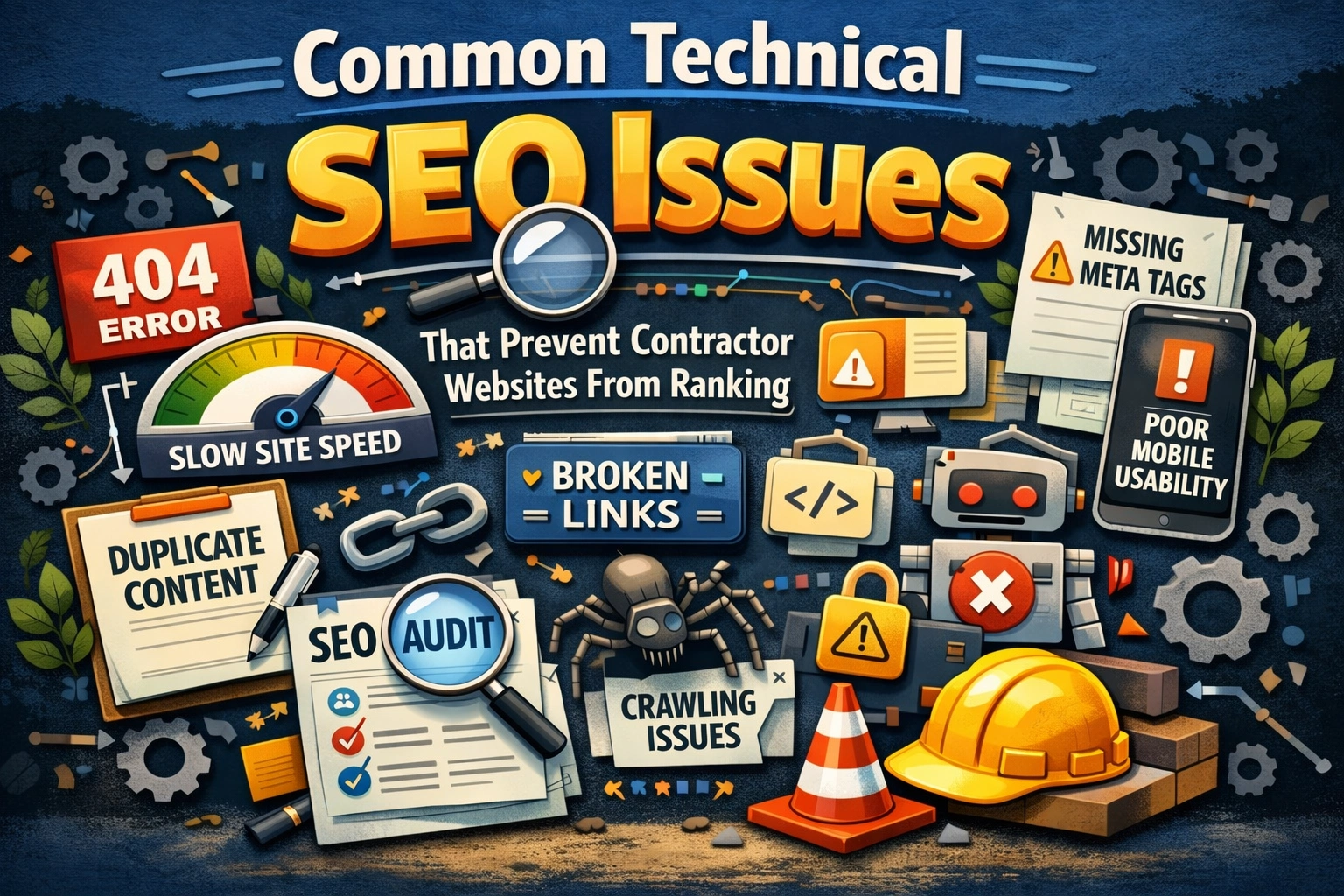
Local SEO mistakes reduce visibility, trust, and lead quality for contractors targeting high-value projects. Inconsistent data, weak profiles, and poor mobile experience signal risk to serious buyers before they ever make contact.
Key takeaways:
- Inconsistent NAP data lowers trust and local rankings
- An inactive Google Business Profile signals low credibility
- Mixing residential and commercial intent reduces relevance
- Low review velocity weakens trust for high-value leads
- Slow mobile sites increase bounce and lost opportunities
- Lack of hyper-local content limits authority and visibility
- Generic SEO strategies fail to attract premium clients
When contractors fix these Local SEO issues, they improve visibility, build trust, and attract higher-value leads that are more likely to convert into profitable projects.
In the high-stakes world of home services, a single digital error can be the difference between a busy season and a stagnant one. High-value projects—such as full-roof replacements, custom kitchen remodels, or whole-home HVAC upgrades—attract a different kind of lead. These clients are research-heavy, risk-averse, and highly sensitive to digital red flags. If your Local SEO strategy is built on outdated tactics or “quick fixes,” you are likely signaling to these premium clients that your business is not ready for their investment.
In 2026, Google’s AI-driven search environment and “Answer Engines” are designed to reward businesses that demonstrate extreme reliability and specialized expertise. When you make a fundamental SEO mistake, you are not just losing a ranking position. You are losing the “digital handshake” that establishes you as a premium professional. To capture high-ticket contracts, you must eliminate the silent killers that undermine your authority.
The Danger of Inconsistent NAP Data
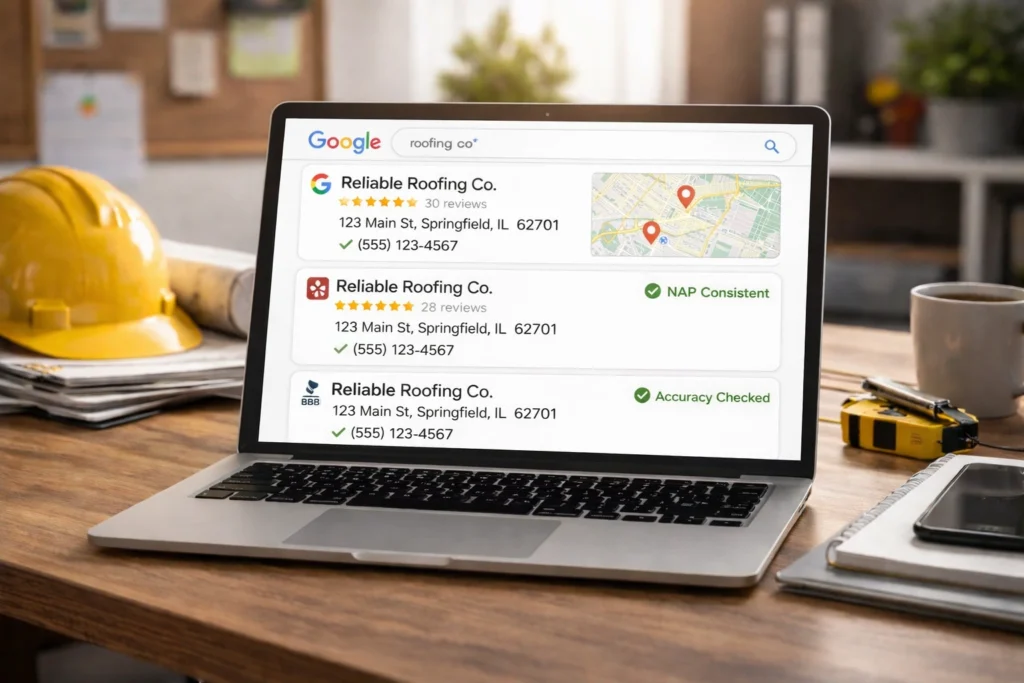
The most basic yet most damaging mistake is inconsistent Name, Address, and Phone Number (NAP) data. In 2026, search engines treat your business as an entity that must be verified across dozens of sources simultaneously. If your business name appears as “ABC Plumbing” on Google but “ABC Plumbing & Drain” on Yelp, or if your phone number varies slightly between directories, you trigger a “trust mismatch” in the algorithm.
For the homeowner looking to spend $20,000 on a project, consistency equals stability. When search engines detect conflicting information, they lower your visibility because they cannot verify your legitimacy with 100% certainty. High-value leads rarely scroll past the top three results. If a “data mismatch” pushes you to the second page, you have effectively surrendered your most profitable leads to a competitor who simply kept their records clean.
Treating GBP as a Listing Instead of a Sales Asset
Many contractors treat their Google Business Profile (GBP) like a static phone book entry. They set it up once and never touch it again. In 2026, this is a fatal error. Your profile is now a dynamic sales asset that potential clients use to vet your recent activity.
A profile with no recent posts, no updated project photos, and an empty Q&A section looks like a business that is either struggling or out of touch. High-value clients want to see that you are active in their specific neighborhood. If your last project photo was uploaded two years ago, the client will assume your best work is behind you. Weekly updates, recent “Proof of Work” photos, and a populated Q&A section tell the high-value lead that you are an active, thriving expert who is ready to take on their complex project.
Mixing Residential and Commercial Search Intent
A common mistake among multi-trade firms is attempting to target residential homeowners and commercial facility managers on the same page. In 2026, the algorithm is highly sensitive to “Micro-Intent.” Residential clients look for words like “trustworthy,” “family-owned,” and “emergency repair.” Commercial clients look for “bonded,” “certified,” “project management,” and “preventative maintenance.”
When you mix these intents, you dilute the relevance of your content. A homeowner does not want to read about industrial boiler specifications, and a facility manager does not care about “same-day residential drain cleaning.” By trying to speak to everyone, you end up speaking to no one. High-value projects require specialized content. To win the big contracts, you must create dedicated funnels that speak directly to the specific needs and fears of each audience.
The “Velocity Gap” in Review Management
In the past, contractors would run a “review blitz” to get fifty reviews in a month and then stop. In 2026, total review count is far less important than “Review Velocity” and “Sentiment Depth.” If your last review was from six months ago, the high-value client perceives your business as “stale.”
Furthermore, “thin reviews” that only say “Great job” no longer move the needle for high-ticket leads. Premium clients look for detailed testimonials that mention the specific service, the neighborhood, and the professionalism of the crew. If your review strategy does not encourage these detailed, recent stories, you are failing to provide the social proof that high-value projects require. A steady stream of two or three detailed reviews per month is infinitely more valuable than five hundred reviews from three years ago.
Ignoring Mobile Page Speed and “Thumb-Friendly” Design
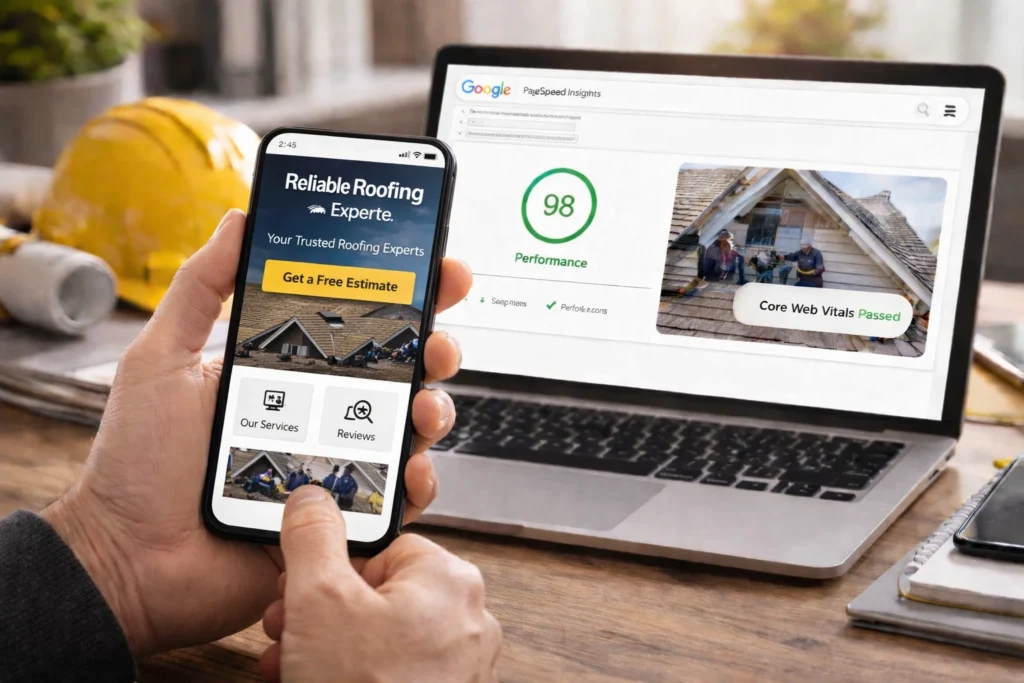
Most local searches for home services occur on mobile devices, often while the homeowner is standing in the middle of the problem area. If your website takes more than three seconds to load, or if your “Call Now” button is buried in a tiny menu, the high-value lead will bounce.
High-ticket clients value their time. If your site is slow, it signals that your physical work might also be inefficient. In 2026, “Interaction to Next Paint” (INP) is a critical ranking factor. A site that feels sluggish or has intrusive popups that block the mobile screen is a major red flag. Your website must be a frictionless path to a conversation. If the user has to pinch and zoom to find your contact information, they will simply click the next contractor in the Map Pack.
The Absence of Localized Authority Signals
High-value projects are almost always local. A homeowner wants to know that you have successfully completed similar projects in their specific town or neighborhood. A major mistake is having a website that feels generic or “national.”
If your service pages do not mention local landmarks, regional weather challenges, or specific city building codes, you are failing to establish “Local Authority.” In 2026, Google rewards “Hyper-Local” content. Mentioning that you specialize in “Historic Home Renovation in the Heights District” provides the geographic context that AI assistants use to recommend you for premium, niche projects. Generic content leads to generic, low-value leads. Specific content leads to high-value contracts.
Conclusion
Local SEO for contractors in 2026 is no longer about “tricks” or “hacks.” It is about eliminating the friction and doubt that prevent a high-value client from picking up the phone. By fixing your NAP consistency, treating your Google profile as a live portfolio, and tailoring your content to specific search intents, you transform your digital presence from a simple listing into a high-performance sales machine. The contractors who avoid these common mistakes are the ones who will claim the most profitable projects in their territory, leaving the low-margin “price shoppers” to their less-diligent competitors.