Local Service Ads let home service companies pay per lead instead of per click, and they show up above traditional Google Ads at the very top of the search results page. Google Ads costs more to manage well, but it gives you far more control over keywords, budget, and where clicks land. Most established contractors don’t pick one over the other. They run Local Service Ads for low friction local leads and Google Ads for the searches that need more precision.
This guide breaks down what each platform actually costs, how ranking works for each one, and how to decide where your marketing budget should go first.
Key Takeaways
- Local Service Ads charge per lead, typically $25 to $120 or more by trade, while Google Ads charges per click whether or not that visitor ever picks up the phone.
- Local Service Ads appear above traditional Google Ads at the top of the results page, and carry the Google Guaranteed or Google Screened badge once you pass a background check and license and insurance verification.
- General contractors and construction companies see some of the roughest Google Ads economics in home services, with average cost per lead reported above $165 and click-to-lead conversion under 3 percent.
- Local Service Ads ranking depends on your review count, star rating, and how quickly you respond to calls and messages, not on how much you’re willing to spend.
- Home service companies spending $3,000 to $5,000 or more a month on paid ads typically split that budget close to evenly between Local Service Ads and Google Ads instead of relying on one channel alone.
- Google credits back invalid Local Service Ads leads, like wrong service area or spam contacts, a protection the per-click Google Ads model doesn’t include.
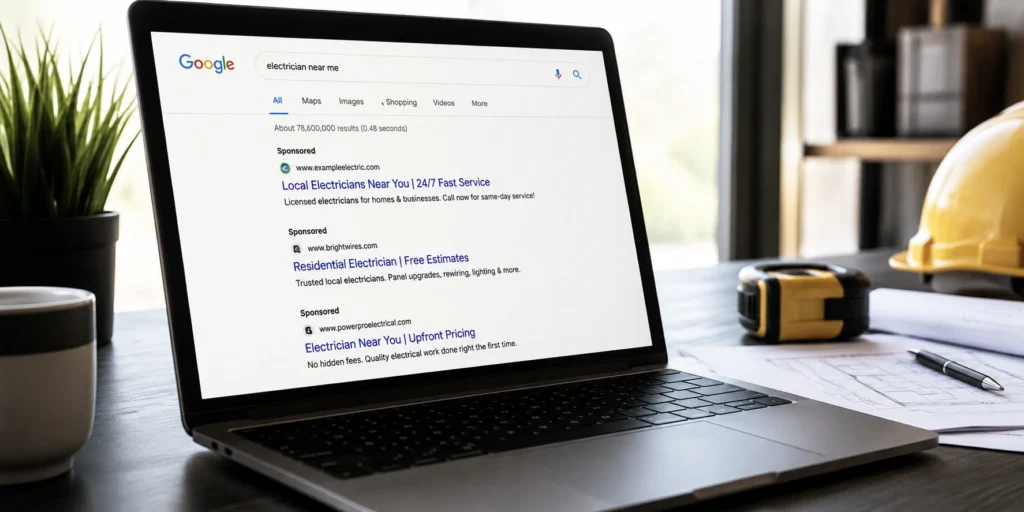
Google Ads and Local Service Ads: What Each One Actually Is
Before comparing costs or results, it helps to know exactly what you’re paying for with each platform.
What Are Local Service Ads
Local Service Ads (LSAs) are Google’s pay-per-lead advertising product, built for home service and trade businesses. They appear at the very top of the results page, above traditional Google Ads and the Map Pack, showing your business name, star rating, city, and a Google Guaranteed or Google Screened badge. You’re only charged when someone calls or messages through the ad. Earning that badge means passing a background check and license and insurance verification, typically one to three weeks.
What Are Traditional Google Ads
Traditional Google Ads, often called Search Ads or PPC, are the ads marked “Sponsored” that sit below Local Service Ads and link to a landing page you choose. You pay for every click, whether that visitor calls, fills a form, or leaves without doing either. In exchange, you get real control over which keywords trigger your ad, what the copy says, where people land, and how much you bid by time of day or location. That control is powerful, but it also means ongoing management to stay profitable.
Cost Comparison: Pay-Per-Lead vs Pay-Per-Click
Comparing Local Service Ads to Google Ads on cost alone is tricky, because you’re not comparing the same unit. One charges for contact, the other charges for a click.
Local Service Ads costs vary by trade and market. Industry benchmarking in 2026 puts typical per-lead costs at roughly $40 to $85 for HVAC, $35 to $75 for plumbing, $50 to $120 for roofing, and $35 to $70 for electrical work. You only pay when a real customer reaches out, and you can dispute leads that don’t match your service area or turn out to be spam.
Google Ads works differently. Cost per click for contractor keywords typically runs $8 to $35 for HVAC, $10 to $40 for plumbing, and $12 to $45 for roofing, depending on market competition. With a landing page converting at 10 to 15 percent, a solid target for service businesses, real cost per lead usually lands between $50 and $250. General contractors and construction companies tend to land at the expensive end: recent benchmarking shows average Google Ads cost above $165 per lead for this group, with click-to-lead conversion under 3 percent, the weakest of any home service category tracked.
| Category | Local Service Ads | Google Ads (Search / PPC) |
| Pricing Model | Pay per lead (a call or message) | Pay per click, regardless of conversion |
| Typical Cost | Roughly $25 to $120+ per lead, by trade | Roughly $8 to $45+ per click; $50 to $250+ per lead after conversion |
| Search Position | Top of page, above Google Ads and the Map Pack | Below Local Service Ads, above organic results |
| Setup Requirements | Background check, license and insurance verification, category selection | Keyword research, ad copy, landing page, conversion tracking |
| Targeting Control | Limited; Google decides when your listing shows | High; choose keywords, locations, schedule, and bids |
| Trust Signal | Google Guaranteed or Google Screened badge | None built in; relies on your reviews and site |
| Best Fit | Smaller budgets, simpler setup, immediate local demand | Larger budgets, service-specific targeting, scaling volume |
The takeaway isn’t that one platform is cheaper. It’s that a $60 lead and a $60 click aren’t the same purchase, and comparing them without conversion rate will point you toward the wrong channel.
Where Each Ad Shows Up in Search Results
On a typical mobile search like “emergency plumber near me,” Local Service Ads appear first, above traditional Google Ads, which sit above the Map Pack, which sits above organic listings.
That order matters because most local contractor searches happen on a phone, where screen space is limited and the top of the page gets nearly all the attention. Ranking in the top three Local Service Ads slots puts you in front of a homeowner before they’ve seen any other option. A strong Google Ads position still gets seen, but it’s competing with everything above it for that first tap or call.
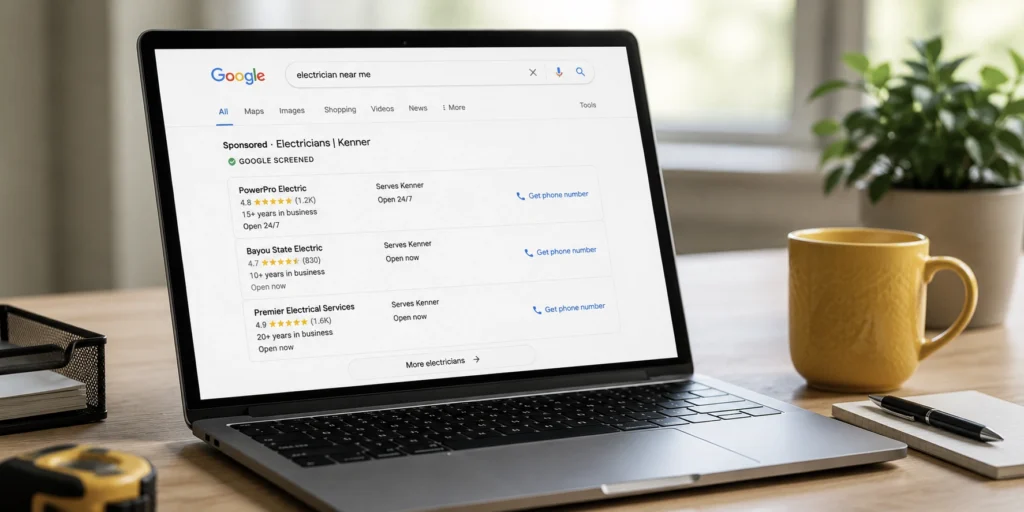
What Actually Determines Your Ranking
Local Service Ads Ranking Factors
Local Service Ads position is set mostly by your review count and rating, how fast you respond to calls and messages, and how complete your service category list is, not by how much you’re willing to spend.
A business with 80 reviews and a 4.7 average will typically outrank one with a dozen reviews and a perfect score, even at similar bids. Miss calls regularly or take a day to answer messages, and Google will quietly suppress your position, regardless of budget. Because ranking and lead volume feed each other, building review count before you launch is worth the extra week or two.
Google Ads Ranking Factors
Google Ads position and cost per click are set by Quality Score, a blend of your bid, expected click-through rate, ad relevance, and landing page experience.
A high Quality Score lowers what you pay for the same position a lower-scoring competitor pays more for. Getting there means separate campaigns by service line, exact or phrase match keywords instead of broad match, a negative keyword list blocking DIY searches and job seekers, and bid adjustments for the evening hours when emergency decisions get made.
Which One Fits Your Business
When Local Service Ads Make Sense
Local Service Ads are the better starting point if you’re new to paid advertising or running under roughly $2,000 a month, since there are no keywords to manage, no landing page to build, and no ad copy to write.
Your profile, categories, and reviews do most of the work. The tradeoff is control: you can’t target a specific high-value service the way you can with Google Ads, so LSAs fit best when you’re comfortable taking whatever mix of jobs comes through.
When Google Ads Makes Sense
Google Ads earns its complexity when you need to target a specific, higher-value service, like roof replacements instead of repairs, or want to scale lead volume past what Local Service Ads alone can generate. It’s also the right move if your Local Service Ads coverage is thin because of category limits or a low review count.
Running Both Together
Most home service companies spending $4,000 to $8,000 a month or more end up running both, typically splitting close to 40 to 50 percent to each.
Local Service Ads capture the top of the page with low friction. Google Ads captures the searches that scroll past them, plus the specific services LSAs can’t target directly. Running both covers more of the page and more of the buying journey than either one alone.
Things to Know
- Under $2,000 a month in ad budget? Start with Local Service Ads: no keyword list, no landing page, no ad copy to test.
- Budget one to three weeks for Local Service Ads approval, since the background check and license and insurance verification take time.
- A Google Ads landing page needs to convert at 10 percent or better to stay cost competitive with typical Local Service Ads lead pricing.
- Dispute bad Local Service Ads leads as soon as you spot them: wrong area, wrong job type, or obvious spam. That recovers real budget every month.
- Track cost per booked job, not just cost per lead or click. A $90 lead that books beats a $40 lead that never answers the callback.
- Reviews and response speed compound on Local Service Ads: better ranking brings more calls, more calls bring more jobs, and more jobs bring more reviews.
Frequently Asked Questions
Is Local Service Ads better than Google Ads for home service companies?
Neither platform is universally better. Local Service Ads usually wins on cost per lead and simplicity, while Google Ads wins on targeting control and the ability to scale volume.
The right choice depends on your budget, how specific your target service is, and whether you’re ready to manage keywords and a landing page.
How much do Local Service Ads cost per lead?
Local Service Ads typically cost $25 to $120 or more per lead depending on your trade, with roofing and other higher-ticket services running toward the top of that range.
Cost also varies by market competition and your review profile. You only pay when a lead actually contacts you, and invalid leads like spam or out-of-area calls can be disputed for credit.
Can you run Google Ads and Local Service Ads at the same time?
Yes. Most established home service companies run both, typically splitting 40 to 50 percent of their paid ad budget to each once monthly spend passes roughly $3,000 to $5,000.
Local Service Ads capture the top of the page with less setup, while Google Ads targets the specific services LSAs can’t reach directly.
Do you need the Google Guaranteed badge to run Local Service Ads?
Yes, in practice. Earning the Google Guaranteed or Google Screened badge, which requires a background check plus license and insurance verification, is part of qualifying for Local Service Ads.
The approval process usually takes one to three weeks. The badge also boosts trust with homeowners, since Google backs the job up to a coverage cap.
Why do general contractors pay more for Google Ads than other trades?
General contractor keywords tend to be broader and less locally specific than trade searches like “plumber near me,” which raises cost per click while lowering the share of clicks that turn into leads.
Recent benchmarking put average general contractor cost per lead above $165 through Google Ads, with click-to-lead conversion under 3 percent, the weakest of any home service category tracked.
Choosing the Right Channel for Your Business
Choosing between Google Ads and Local Service Ads comes down to budget, how specific your target service is, and how much setup you’re willing to manage. Local Service Ads gets you leads with less complexity and a lower cost of entry. Google Ads gives you the control to target exactly the jobs you want and the room to scale once Local Service Ads alone isn’t enough.
For most established contractors, the real answer isn’t choosing one over the other. It’s running both. Construction Marketing Services (CMS) builds and manages Local Service Ads and Google Ads campaigns for contractors across these trades, so if you’re not sure where your budget should go first, that’s worth a conversation before you spend another dollar.