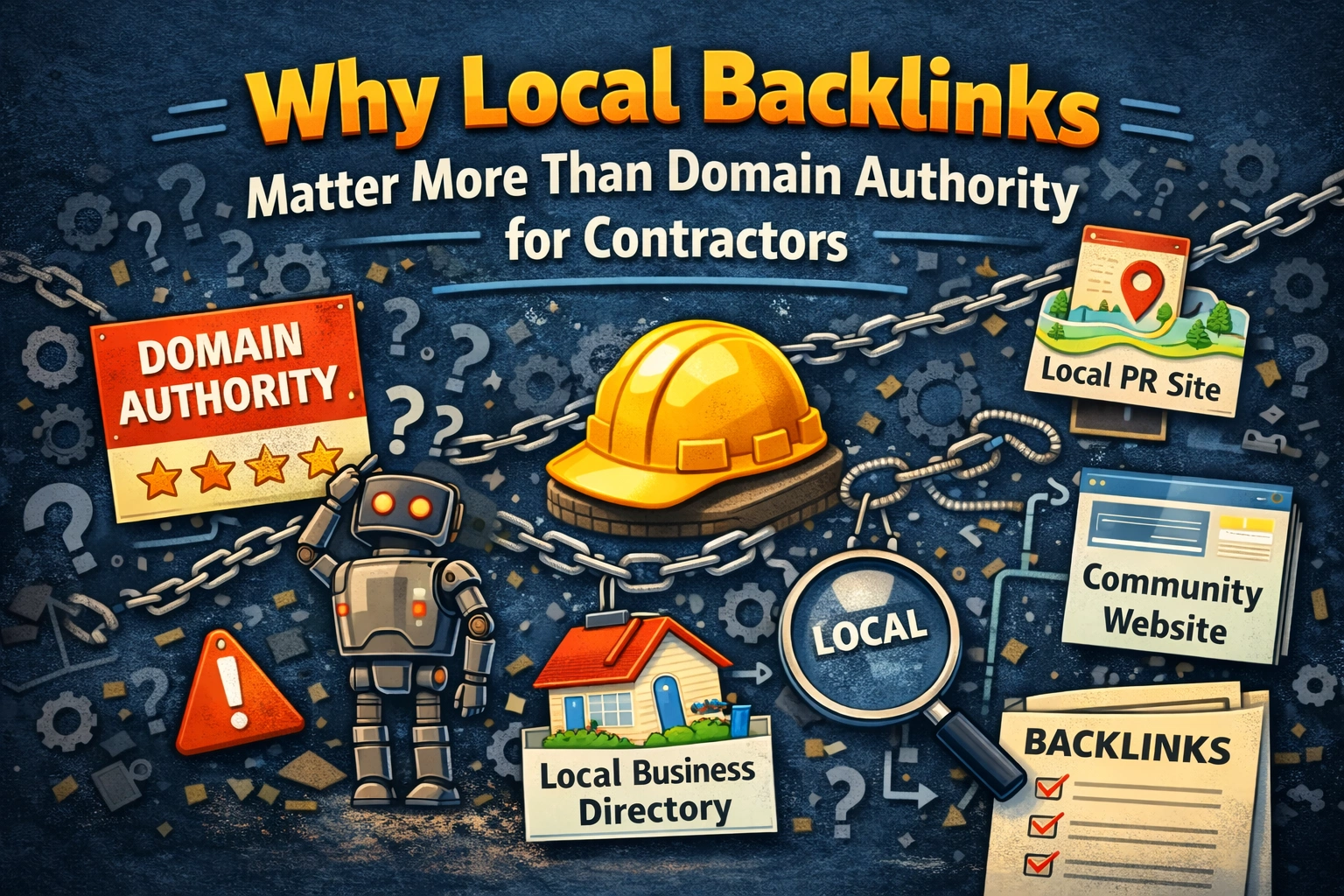
Local backlinks help contractors prove geographic relevance to search engines. Links from community sites, suppliers, and regional organizations build stronger local authority than generic high-domain sites.
Key takeaways:
- Local backlinks signal geographic trust and relevance.
- Community sponsorships often generate high-trust links.
- Manufacturer directories reinforce expertise and location.
- Local citations and mentions strengthen entity signals.
- Local referral traffic converts better than national traffic.
- Strong local link profiles improve map pack visibility.
When contractors prioritize local backlinks over chasing domain authority alone, search engines gain clearer signals about their service area, improving local rankings and lead quality.

In the world of construction SEO, there is a common misconception that a backlink from a massive national website is the ultimate goal. Many contractors spend thousands of dollars trying to get featured on high-authority design blogs or national news outlets, believing that a high Domain Authority (DA) score is the only metric that matters. However, in the 2026 search environment, relevance has overtaken raw power. For a local roofing or plumbing firm, a single link from a local chamber of commerce or a neighborhood news site can carry more weight than ten links from generic national domains.
This shift occurred because search engines now prioritize “geographic intent.” When a homeowner searches for a kitchen remodeler, the algorithm is not looking for the most famous company in the country; it is looking for the most trusted company in that specific zip code. Local backlinks act as digital “proof of residency,” telling the search engine that your business is a verified, active participant in the community you claim to serve.
The Geography of Trust: Local vs. National Links
Domain Authority is a third-party metric that estimates the overall strength of a website, but it does not account for local relevance. A national home improvement blog may have a high DA, but its audience is spread across the entire world. When that site links to you, it provides a general boost in authority but offers zero geographic context. In contrast, a link from a local high school, a regional charity, or a nearby supply house provides a specific location signal.
Search engines use these local connections to build a “proximity profile” for your business. If your link profile is filled with websites based in your specific city or county, the algorithm gains high confidence in your service area. This confidence is the primary driver for ranking in the Local Map Pack. For a contractor, being the “neighborhood favorite” in the eyes of the algorithm is far more profitable than having a high DA score on a global scale.
Verification Through Community Involvement
Local link building is often a byproduct of real-world community involvement. This makes these links incredibly difficult for competitors to fake or buy. When you sponsor a local little league team or donate materials to a regional non-profit, you often receive a link from their “Sponsors” or “Partners” page. Because these organizations manually vet their partners, search engines view these links as high-trust endorsements.
These community-based links are the “gold standard” for local prominence. Unlike guest posts on generic blogs, which are often flagged as “paid” or “sponsored,” a link from a local 5k run or a community garden project is viewed as a natural, earned mention. These signals prove that your business is not just a digital entity, but a brick-and-mortar staple of the local economy.
Manufacturer and Supplier Connections
One of the most overlooked sources of local authority is your existing network of suppliers and manufacturers. Many contractors use specific brands of shingles, windows, or flooring. These manufacturers often have “Find a Contractor” or “Preferred Installer” directories on their websites. While these are technically niche-relevant links, they become powerful local signals when they are filtered by location.
A link from a major manufacturer that points directly to your local service page serves as a dual signal. It confirms your technical expertise in a specific trade while simultaneously pinning your business to a specific geographic point. This combination of topical and local authority is exactly what search engines look for when deciding which firm to recommend for a specialized local search.

The Power of Niche-Relevant Local Citations
While a backlink is a clickable link, a “citation” is any mention of your Name, Address, and Phone Number (NAP). In 2026, the line between a citation and a backlink has blurred. Search engines now recognize “unlinked mentions” on reputable local sites as authority signals. For example, being mentioned in a local news article about a new commercial development provides significant value, even if the reporter did not include a clickable link.
These niche-relevant mentions reinforce your business entity. When your firm is mentioned alongside other local landmarks and businesses, it consolidates your identity in the local “knowledge graph.” This makes it easier for AI-driven search models to cite your business as the primary expert for a specific region. The goal is to create a digital footprint that is so deeply embedded in the local web that your location becomes undeniable.
Referral Traffic: The Hidden Benefit
Beyond the SEO benefits, local backlinks drive a different kind of visitor: the “high-intent” local lead. A person browsing a local neighborhood blog or a city guide is already thinking about their immediate surroundings. When they see a recommendation for your services on a site they already trust, the conversion rate is significantly higher than traffic from a national source.
This “referral traffic” also sends a secondary signal to search engines. If users click a link from a local site and then spend several minutes on your “Request a Quote” page, it tells the algorithm that your site is highly relevant to that local audience. This creates a positive feedback loop where your local links drive engagement, and that engagement further boosts your local rankings.
Conclusion
In the construction industry, your reputation is built on the ground, not in the cloud. Chasing national Domain Authority at the expense of local relevance is a strategic mistake that leaves your business invisible to the customers in your own backyard. By focusing on local backlinks from community organizations, suppliers, and regional news, you provide the geographic proof that modern search engines demand. A locally-anchored link profile is the most effective way to secure your position at the top of the map pack and ensure that when your neighbors search for a contractor, your name is the first one they see.