
Service page SEO for contractors means building each service page, whether it covers roof repair, kitchen remodeling, or HVAC installation, around the exact keywords buyers type when they are close to hiring, then structuring the page so a visitor can confirm in seconds that the business does that job, in that area, and can be reached right now. A page built this way ranks for commercial searches and converts a higher share of the traffic it earns, because it answers what a ready-to-hire visitor is actually looking for instead of describing the service in general terms.
Key Takeaways
- High-intent modifiers such as cost, near me, emergency, same day, and a city name each signal a different stage of readiness, and the page should answer that specific signal in the first screen.
- One dedicated page per core service consistently outperforms a single combined “our services” page, both in rankings and in conversion rate.
- The first 100 words on a service page should confirm the business does this job, serves this area, and can be reached now.
- Proof elements placed near the top of the page, such as reviews, licensing, insurance, and completed project photos, reduce the hesitation that stalls a ready buyer.
- A visible call to action belongs in the first screen of every service page, not only at the bottom after a long block of copy.
- Even a price range or a starting-at figure keeps price-comparing searchers on the page instead of bouncing back to the search results.
What Counts as a High-Intent Search for a Contractor
Not every search related to a service carries the same buying readiness. “How does a heat pump work” and “heat pump installation cost Denver” both mention heat pumps, but the second one carries a location and a decision-stage signal the first never touches. That difference separates an informational search, where the person is still learning, from a high-intent search, where the person is close to picking up the phone. Contractor sites that treat every search the same, burying commercial language inside long educational articles, leave the highest-value traffic with nowhere clear to land.
High-intent searches cluster around a small set of modifiers, and each one signals something specific about what the visitor needs to see first. Cost and price modifiers signal someone comparing numbers before committing to a call. Near me and city-name modifiers signal someone who has already decided to hire locally and is narrowing down who to contact. Emergency and same-day modifiers signal urgency measured in hours, not days. Recognizing which modifier brought a visitor to a page, and building that page’s structure around it, is the core discipline behind service page SEO.
Why Separate Service Pages Outperform One Combined Page
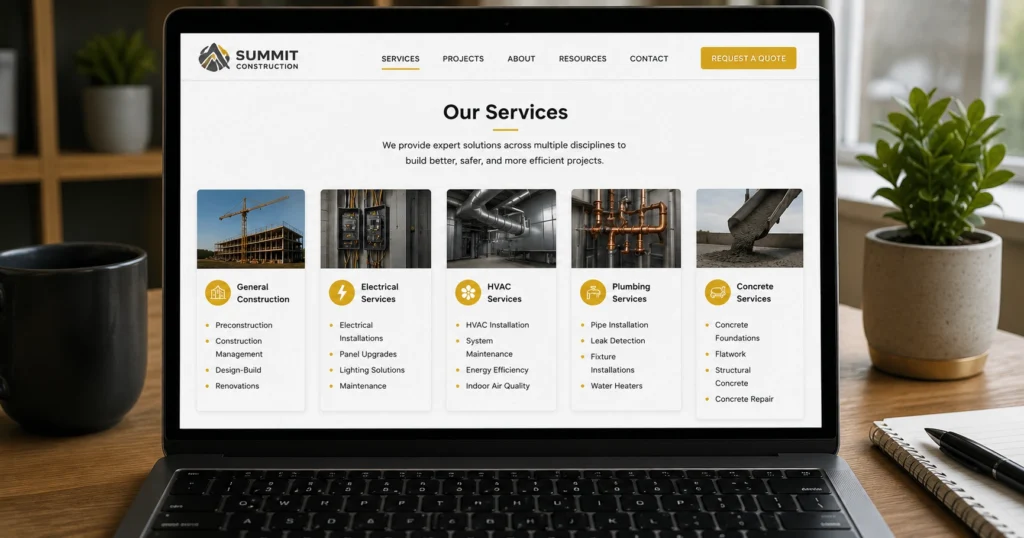
A common pattern on contractor websites is a single “Services” page listing five or six offerings as short bullet points with no dedicated content underneath. That structure makes it hard for the page to earn a strong ranking for any one service, because the title tag, headers, and body copy are split across offerings instead of speaking entirely to one. Search engines match a query to whichever page’s content is most focused on that exact topic, and a combined page rarely wins that match. This is part of why contractor page optimization services exist as their own line of work separate from general web design.
Splitting services into their own pages also solves a conversion problem, not just a ranking one. A roof replacement page can lead with project photos. An emergency plumbing page can lead with a phone number and same-day availability. A kitchen remodel page can lead with a portfolio gallery. None of that specificity is possible on a page trying to represent five services at once with generic language that has to apply to all of them.
- A unique title tag and H1 built around that one service and the primary area served.
- An opening paragraph naming the service, the area, and a reason to trust this business specifically.
- Proof elements relevant to that exact service, not a general testimonials block shared sitewide.
- A call to action worded for that service’s typical urgency level.
- Original images from actual completed jobs, not stock photography reused across pages.
Structuring the Page to Match What a Buyer Needs
Once a service has its own page, the order of information matters almost as much as the words themselves. The first screen, everything visible before a visitor scrolls, should answer whether this business does the job, works in their area, and can be reached now: a headline combining the service and location, one confirming sentence, a phone number or contact button, and a trust signal such as a review rating or license number. Getting this part right is closely tied to understanding practical contractor search intent, since the structure only works if it is mapped to the actual intent behind the keyword it targets.
The middle of the page carries the detail a visitor wants before committing: what the service includes, roughly what it costs, and which neighborhoods are served, along with before-and-after photos and any relevant certifications. The bottom is the right place for a short FAQ, a second call to action, and links to closely related service or location pages.
Placing Keywords Without Stuffing the Page
The primary keyword and service area belong in the title tag, the H1, and the first hundred words, stated plainly. From there, secondary keywords should appear across the H2 subheadings rather than repeating the same phrase every few sentences. A page that reads naturally to a person will almost always satisfy what a search engine checks for. The broader rules are covered in the contractor on-page SEO checklist, which applies the same logic sitewide.
Images deserve the same treatment. A photo of a finished project should carry a descriptive file name and alt text naming the service and, where relevant, the material or location, rather than a generic label left over from a phone’s camera roll, a detail covered separately in practical contractor image SEO.
Proof Elements That Convert High-Intent Visitors
A visitor who reaches a service page through a high-intent search has usually already decided the service is needed. What that visitor is still deciding is which business to trust, and proof elements settle that decision. Review ratings, license and insurance numbers, and manufacturer certifications belong near the top rather than buried at the bottom, since a hesitant visitor who has to hunt for reassurance often leaves. This proof works alongside the broader contractor SEO expertise behind the page, since ranking well only pays off once the page earns the click’s trust.
Local proof matters as much as general credibility for pages tied to a specific area. Naming the neighborhoods actually served and showing recent project examples from those areas signals that this business genuinely works nearby, rather than just claiming a broad service radius on a template page.
- Review rating and review count visible without scrolling.
- License number, insurance status, and relevant manufacturer certifications.
- Before-and-after photos or a short project gallery specific to that service.
- A named list of neighborhoods, towns, or zip codes actually served.
- A short, specific testimonial tied to that exact service, not a generic one reused sitewide.
Common Mistakes That Waste High-Intent Traffic
Even well-ranked service pages regularly lose visitors who were already sold on hiring, usually from a handful of repeatable mistakes. The most common one in construction is publishing near-duplicate pages for closely related services, such as roof repair and roof replacement, with the same paragraphs reworded and the keyword swapped. Search engines struggle to know which page deserves to rank, and visitors often land on the wrong one.
- Publishing thin or duplicate content across similar services instead of writing distinct pages for each one.
- Placing the phone number or contact form only at the very bottom of a long page.
- Using generic stock photography instead of real project images from completed jobs.
- Combining multiple unrelated services on one page instead of splitting them out.
- Leaving out local signals such as service area, nearby project examples, or local reviews.
- Slow-loading pages on mobile, where the majority of emergency and near-me searches happen.

High-Intent Search Modifiers and What They Signal
The table below maps the most common high-intent modifiers in contractor searches to what each one signals and how a service page should respond to it.
| Search Modifier | Example Search | What It Signals | How to Address It on the Page |
| Cost / price | “how much does a new roof cost” | Comparing prices, not ready to browse casually | Show a price range or starting-at figure, link to a quote or pricing page |
| Near me / [city] | “roofing company near me” | Local, comparing two or three options, close to calling | Lead with service area, phone number, and local proof above the fold |
| Emergency / same day | “emergency plumber same day” | Urgent, will hire within hours | Put the phone number and availability in the first screen, shorten the contact form |
| Best / top rated | “best HVAC company in [city]” | Comparing reputation and reviews before contacting | Feature review count, rating, and license or insurance details near the top |
| Vs / difference | “tankless vs tank water heater cost” | Comparison research, may not convert on this visit | Answer the comparison directly, then link to the specific service page |
Things to Know
- Every service page should be reachable within two clicks from the homepage.
- Roof repair, roof replacement, and roof inspection each need distinct content; swapping the keyword on an identical page creates duplicate-content risk.
- Mobile page speed carries extra weight for call-heavy searches, since a slow page during an emergency search gets abandoned fast.
- Service and LocalBusiness schema markup helps search engines understand exactly what the page offers and where.
- Blog articles that link into a service page pass along relevance and authority, part of why internal linking is planned alongside page structure.
- Testimonials should be specific to the service on that page, not a generic block of praise reused sitewide.
Frequently Asked Questions
What makes a keyword “high intent” for a contractor?
A high-intent keyword includes a modifier like cost, near me, emergency, or a city name that signals the searcher is close to hiring, not just researching.
Informational searches like “how does a heat pump work” sit earlier in the buyer’s process. A search like “heat pump installation cost Denver” carries a location and decision-stage signal, which is why it deserves a dedicated, tightly matched page rather than a mention buried inside a broader article.
Should contractors have a separate page for each service, or one combined page?
Separate pages for each core service consistently outperform a single combined services page, both in rankings and in conversion rate.
A dedicated page lets the title tag, headers, and body content stay entirely focused on one service, which search engines match more precisely. It also lets the proof, pricing, and call to action speak directly to that service instead of generic language meant to cover five services at once.
How much content does a high-intent service page actually need?
Enough to answer what the service includes, what it costs, who provides it, and how to book it, which usually lands between 500 and 900 words of unique page copy plus supporting proof elements.
Padding a page to hit a word count usually hurts more than it helps, since a ready-to-hire visitor is scanning for specific answers. The right length is whatever it takes to cover the service, the area, the process, and the proof without repeating the same sentence in different words.
Where should the call to action go on a contractor service page?
At least one clear call to action belongs in the first screen the visitor sees, before any scrolling, with additional CTAs repeated after the proof section and again at the bottom of the page.
A ready-to-hire visitor who has to scroll past several paragraphs to find a phone number often leaves for a competitor’s page instead. Placing the CTA early does not mean cutting the rest of the page; it means giving an obvious next step the moment they arrive, with more chances to convert as they read on.
Do service and location need to be combined on the same page, or kept separate?
For a business serving several distinct towns or neighborhoods, a combined service-plus-location page (such as roof repair in a specific city) usually converts better than a single citywide service page trying to cover an entire region.
A combined page lets the headline, proof, and examples speak to that specific area, matching how a local searcher phrases the query. A business serving one metro area without meaningfully distinct neighborhoods can usually keep service pages broader without splitting them by location.
Bringing It Together on Every Service Page
Service page SEO for contractors comes down to matching structure to intent: a dedicated page for each service, a first screen that confirms the business can do the job in that area right now, proof placed where hesitation happens, and keywords used the way a real customer would phrase them. None of these pieces work in isolation. A perfectly worded page with the call to action buried at the bottom still loses ready buyers, and a well-designed page with no location or proof signals still fails to rank for the searches that matter most. Treating each service page as its own small conversion project is what turns high-intent search traffic into booked jobs instead of just visits.


