Service pages and location pages solve two different problems on a contractor website: a service page explains what a business does, while a location page or service area page confirms where they do it. Confusing the two, or worse, cramming both jobs onto a single page, usually means neither page ranks as well as it should, and thin, templated location pages risk being flagged as doorway pages by Google’s 2026 helpful content systems.
Practical local SEO for contractors depends heavily on getting this structure right, since it determines whether a site can actually compete for both service-specific and location-specific searches at the same time.
Key Takeaways
- A service page explains what a contractor does. A location or service area page confirms where they do it. Each needs its own dedicated page to rank well.
- Templated location pages that only swap out a city name, with no real local detail, risk being flagged as doorway pages by Google’s 2026 helpful content classifier.
- Location pages should carry 500 to 1,000 words of genuinely unique content per page, not a copy-pasted template with the city name changed.
- URL structure that combines the service and the city, like /ac-repair-plano, performs better than a generic service area statement buried in an About page.
- A business with a physical office should use true location pages, complete with address and hours, while businesses that travel to clients without a storefront use service area pages instead.
- Publishing new location pages in large batches all at once is a red flag to Google. Rolling them out gradually, with real unique content each time, is the safer approach.
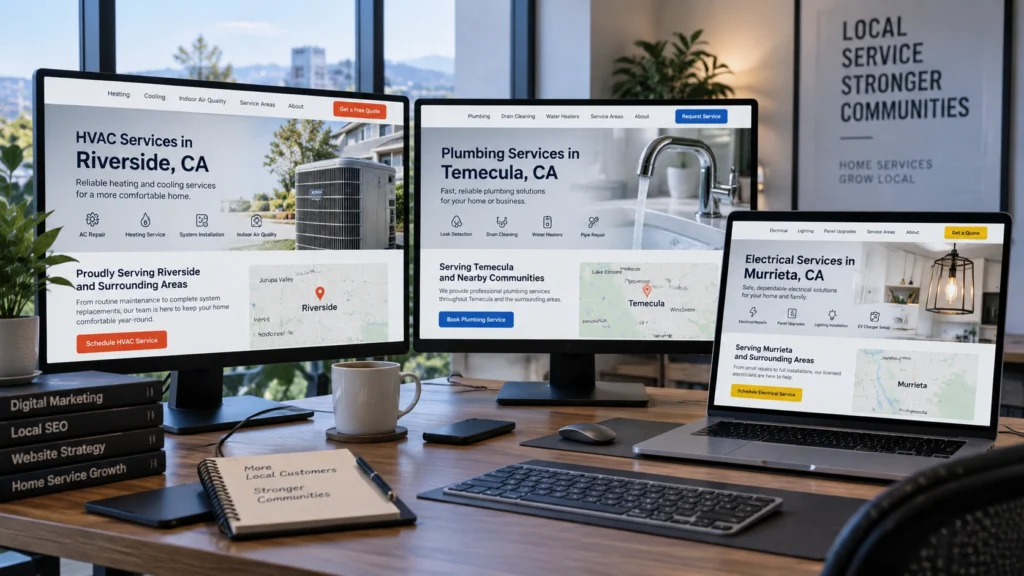
What Each Page Type Is Actually For
Service Pages
A service page answers one question: what does this business actually do? A page dedicated to kitchen remodeling covers the process, materials, typical project scope, and what sets that service apart, without trying to also carry the weight of every city the business serves.
This focus is what lets a service page rank for competitive, service-specific searches. A page that clearly and thoroughly answers “what’s involved in a kitchen remodel” has a real shot at ranking for that broad, high-volume question. A page splitting its attention between explaining the service and listing five cities rarely does either job well enough to compete.
Location and Service Area Pages
A location page or service area page answers a different question: where does this business do that work? A business with a physical storefront clients actually visit uses a true location page, complete with an address and hours. A business that travels to clients without a public-facing office, which describes most contractors, uses a service area page instead, describing coverage without publishing a street address that doesn’t apply.
The distinction matters beyond just accuracy. Publishing a fake or misleading address for a business that has no actual public office at that location can create real problems with Google Business Profile guidelines, on top of confusing customers who might show up expecting to find a storefront that doesn’t exist.
Why Combining Them Usually Backfires
Cramming service details and location details onto a single page often means neither does its job well. A page trying to describe kitchen remodeling in general while also claiming relevance for five different cities usually reads as vague to both search engines and visitors, since it isn’t specific enough about the service or specific enough about any one location.
This shows up clearly in how these pages tend to be written. A combined page usually opens with a paragraph about the service, adds a sentence listing the cities served, and calls it done. Neither section gets the depth needed to actually rank, and a visitor searching for a specific city gets a page that barely mentions it beyond a passing reference in a bulleted list.
Local ranking services for contractors work by matching search intent as precisely as possible, and a page trying to serve two intents at once rarely matches either one as precisely as a dedicated page would.
The Doorway Page Risk Most Contractors Don’t Know About
A doorway page is a thin page built mainly to rank for a keyword, usually a city name, with little genuine value beyond that. Google’s helpful content systems in 2026 actively flag these, and the classic contractor version is a location page that’s identical to every other location page on the site except for a swapped city name.
The risk isn’t limited to the flagged pages themselves either. When Google identifies a pattern of doorway pages across a site, it can suppress rankings more broadly, treating the pattern as a signal about the site’s overall content quality rather than an isolated issue with a handful of pages. A contractor who built thirty near-identical city pages hoping for a quick ranking boost can end up worse off than one who never built them at all.
| Attribute | Service Page | Location / Service Area Page |
| Answers the question | What do you do? | Where do you do it? |
| URL example | /kitchen-remodeling/ | /kitchen-remodeling-austin/ |
| Core content | Process, materials, project types, pricing factors | Local project examples, service area specifics, local trust signals |
| Typically one per | Distinct service offered | City or region served |
| Biggest risk if done poorly | Vague, generic content that doesn’t rank for anything specific | Thin, templated duplicate content flagged as a doorway page |
The table above isn’t just a reference. It’s a diagnostic: if a site’s location pages only differ in the column labeled “Core content” by a city name and nothing else, that’s the doorway page pattern search engines are trained to catch.
What Makes a Location Page Actually Unique
Avoiding the doorway page trap comes down to including real, city-specific substance on every page. A useful checklist:
- Real local project examples or before-and-after photos from that specific area
- Mention of neighborhoods, landmarks, or sub-areas actually served, used naturally rather than as filler
- Service area boundaries clearly stated, so both customers and Google know exactly where coverage extends
- Local trust signals: reviews from that area, local certifications, or permits specific to that municipality
- A clear call to action tied to that specific location, not a generic sitewide contact form
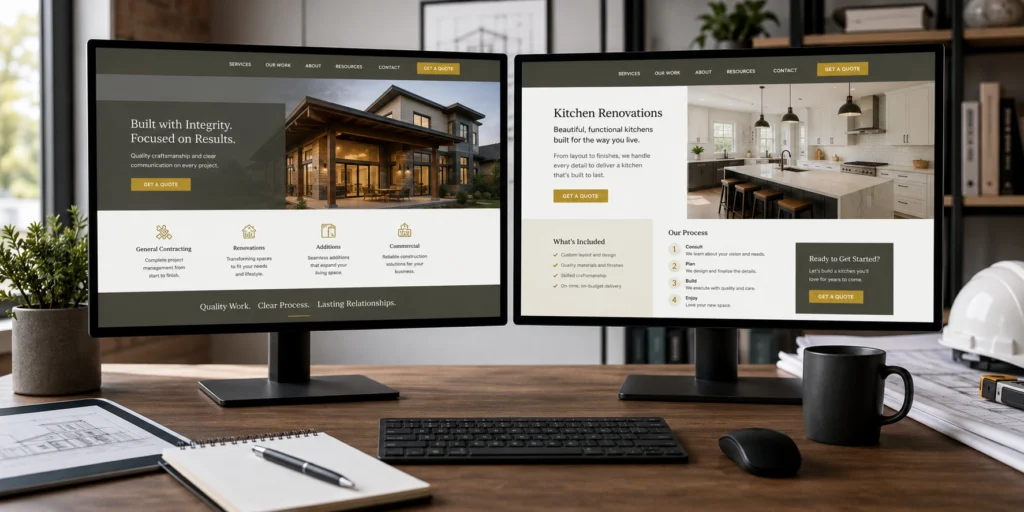
Connecting the Two: Internal Linking Structure
Contractor service area pages strategy depends heavily on how these pages link to each other. Each location page should link back to the relevant service page it supports, and each service page should link out to the location pages covering the areas that service is offered in. This creates a clear structure that distributes authority across the site rather than leaving location pages isolated with no internal support.
A site with strong service pages but no links pointing to its location pages is wasting some of that authority. Search engines follow internal links to understand which pages matter and how they relate to each other, so an isolated location page with no inbound links from anywhere else on the site sends a weaker signal than one woven naturally into the site’s structure.
Practical local citations for contractors reinforce this same structure from outside the website, confirming the same city and service combinations that the internal linking already establishes.
Things to Know
- 500 to 1,000 words of genuinely unique content per location page is a reasonable target. Thin pages under 300 words rarely hold up over time.
- Publish new location pages in small batches, not dozens at once, since sudden large page sets can trigger doorway page scrutiny.
- A service area page for a city with no physical office should skip publishing a street address, since there isn’t one to list.
- Location page URLs that combine the service and the city tend to perform better than a generic “service areas” page listing every city in one place.
- Not every city needs its own page. Prioritize the 15 to 30 markets that actually generate meaningful search volume or revenue.
- A location page with zero unique content beyond a swapped city name is worse than no page at all, since it dilutes the site’s overall quality signals.
Frequently Asked Questions
What’s the difference between a service page and a location page?
A service page explains what a contractor does, like kitchen remodeling or roof repair. A location page confirms where that service is offered, tied to a specific city or region.
Both matter for different searches. Someone searching “kitchen remodeling contractor” wants the service page, while someone searching “kitchen remodeling Austin” is better served by a location-specific page.
Can a contractor combine service and location information on one page?
It’s possible for a single-location business with one clear service area, but multi-city or multi-service contractors usually see better rankings by separating the two.
Combining everything onto one page often means neither the service depth nor the local specificity is strong enough to rank well for either type of search.
What is a doorway page, and why does it matter for location pages?
A doorway page is a thin, templated page created mainly to rank for a keyword, offering little unique value beyond a swapped city name, and Google’s 2026 helpful content systems actively flag these.
The safest way to avoid this is genuine local content: real project examples, specific service area details, and local trust signals rather than a copy-pasted template repeated dozens of times.
How many words should a location page have?
Roughly 500 to 1,000 words of genuinely unique content is a reasonable target for a location page.
The word count matters less than what fills it. A thin page padded with filler to hit a number performs worse than a shorter page with real, specific local detail.
Should every city a contractor serves get its own page?
Not necessarily. Prioritizing the 15 to 30 markets that generate meaningful search volume or revenue usually outperforms creating a page for every city served.
Publishing dozens of thin pages for minor markets spreads quality thin and increases the risk of doorway page issues, while a smaller set of strong pages tends to perform better overall.
Building Pages That Do Their Job
Service pages and location pages aren’t competing for the same job. One explains what a contractor does, the other confirms where, and building both correctly, with real distinct content, is what lets a site rank for both types of searches instead of neither.
SEO help for builders and trades from Construction Marketing Services includes structuring exactly this kind of service and location page architecture, prioritized around the markets and services that actually drive revenue. If a website’s location pages all read like the same template with a city name swapped in, that’s usually the first thing worth fixing.