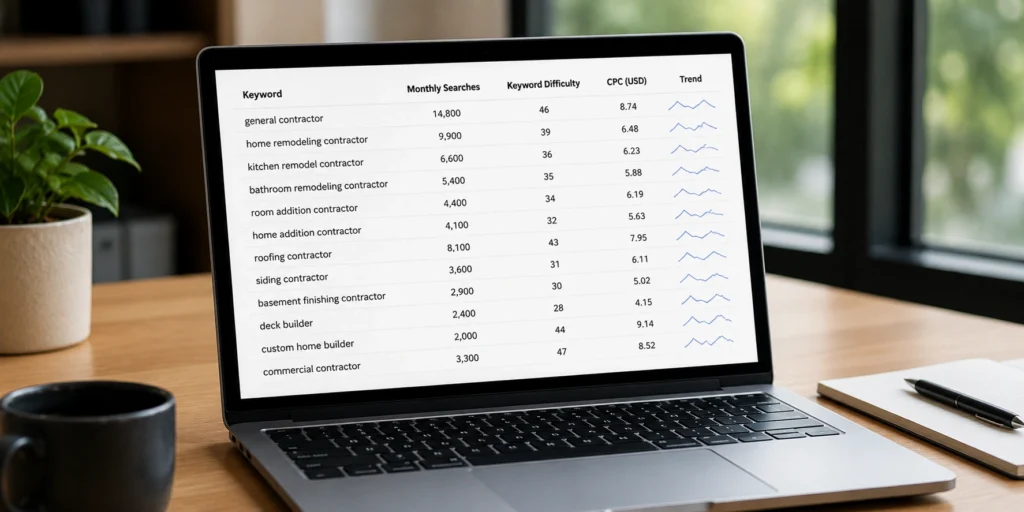
Keyword research for contractors means finding and prioritizing the exact phrases potential clients type into Google before hiring someone, then building content and pages around the ones that actually lead to booked jobs rather than the ones that simply get the most searches. The biggest mistake in contractor keyword research isn’t picking the wrong words. It’s chasing search volume over buyer intent, since a keyword with 10,000 searches a month is worthless if none of those searchers are ready to hire.
Getting this right shapes everything downstream: which pages get built, what content gets written, and whether traffic turns into calls or just adds to a bounce rate nobody’s watching.
Key Takeaways
- Long-tail keywords, phrases of four or more words, make up nearly half of all searches and typically convert better than short, broad terms.
- 97 percent of construction clients research contractors online before making contact, so keyword targeting shapes the first impression before a single call happens.
- Ranking in the top 3 for 20 to 30 relevant keywords can be worth the equivalent of $15,000 to $40,000 a month in comparable ad spend.
- Informational keywords like “what does a general contractor do” attract researchers who are months from hiring, while “service plus city” keywords attract people ready to book.
- “Near me” and city-specific searches drive the majority of contractor clicks through Google’s local map pack, not the standard organic results below it.
- Checking what actually ranks for a keyword reveals its real intent faster than any keyword tool, since Google’s own results show who it thinks that search is for.
For the fuller picture of contractor SEO overall, see our construction SEO fundamentals guide. This piece goes deep specifically on finding and prioritizing the keywords worth building a strategy around.
Why Keyword Research Matters More Than It Looks Like It Should
Keyword research determines the return on every other SEO investment a contractor makes. Content, technical fixes, and link building all compound in value when they’re built around keywords people actually search with buying intent, and all of it underperforms when built around the wrong terms, no matter how well-executed the rest of the work is.
The numbers make the stakes clear. Ranking in the top 3 positions for 20 to 30 relevant keywords can be worth the equivalent of $15,000 to $40,000 a month in comparable ad spend, and each organic lead typically saves $40 to $150 compared to buying the same lead from an aggregator platform. Practical contractor SEO pricing only makes sense when it’s pointed at keywords that actually convert. The same budget aimed at the wrong terms produces traffic with nothing behind it.
This is also why keyword research should happen before content gets written, not after. A contractor who builds a blog calendar around topics that sound useful, then checks keyword data afterward, usually finds a mismatch between what got written and what people actually search. Reversing that order, starting from real search data and building content to match, produces pages that were built to rank from the beginning instead of pages retrofitted to chase traffic after the fact.
The Three Types of Search Intent Contractors Need to Know
Informational Searches
Informational searches come from people still researching, often months away from hiring anyone. A search like “what does a general contractor do” or “how to choose a roofing contractor” signals someone building general knowledge, not comparing specific businesses yet. These keywords still matter, but they belong on blog content that builds trust and authority, not on a service page trying to convert a booking.
Commercial and Transactional Searches
Commercial and transactional searches come from people actively comparing options or ready to hire. “Roof replacement [city]”, “emergency plumber near me”, and “best general contractor in [city]” all signal a searcher close to a decision. Commercial construction searches carry their own distinct vocabulary too, procurement terms like RFP, tender, and bid, along with project specifications like square footage, which signal a longer sales cycle but a significantly higher project value once they convert.
A general contractor bidding on both residential remodels and commercial tenant improvements needs separate keyword strategies for each, since a homeowner searching “kitchen remodel near me” and a facilities manager searching “tenant improvement contractor RFP” are looking for completely different signals of trust and capability, even though both searches could technically lead to the same company.
Keyword Categories That Actually Generate Jobs
Breaking contractor keywords into categories makes it easier to prioritize which ones deserve a dedicated page versus a supporting blog post.
| Keyword Type | Example | Typical Searcher Intent |
| Informational | “how to choose a roofing contractor” | Researching, likely months from hiring |
| Service + Location | “roof replacement [city]” | Actively comparing local contractors |
| “Near Me” | “roofer near me” | Ready to hire, wants immediate local options |
| Emergency / Urgent | “emergency roof leak repair” | Needs help now; high urgency and conversion |
| Commercial / Procurement | “commercial roofing RFP” | B2B, longer sales cycle, higher project value |
| Comparison | “best roofer in [city]” | Comparing specific options before deciding |
Most contractors have plenty of content around the informational end of this table and almost nothing built around the emergency, near-me, and commercial categories, even though those are the ones most directly tied to booked jobs.
How to Actually Find the Right Keywords
Google’s autocomplete and “People Also Ask” sections reveal the exact phrases real people search, often surfacing language a contractor would never think to target on their own. Typing a partial query and seeing what Google suggests, then checking the related questions that appear in the results, is faster and more revealing than most paid keyword tools for this kind of intent-mapping.
Checking what already ranks for a candidate keyword is just as useful. Searching “best home siding” without a location typically returns large publisher sites like established home improvement magazines, since Google reads that query as informational and broad. Adding a city, “best home siding [city]”, changes the results entirely to local business listings, since the added location signals local, transactional intent. That shift in results is a faster, more reliable intent check than any keyword tool’s difficulty score.
Reviewing actual customer calls, past inquiries, and reviews rounds out the picture, since real customers rarely describe their problem using industry terminology. A homeowner doesn’t search for “polyaspartic coating installation.” They search for “garage floor paint that doesn’t peel,” and content built around that second phrase captures searches the industry term never would.
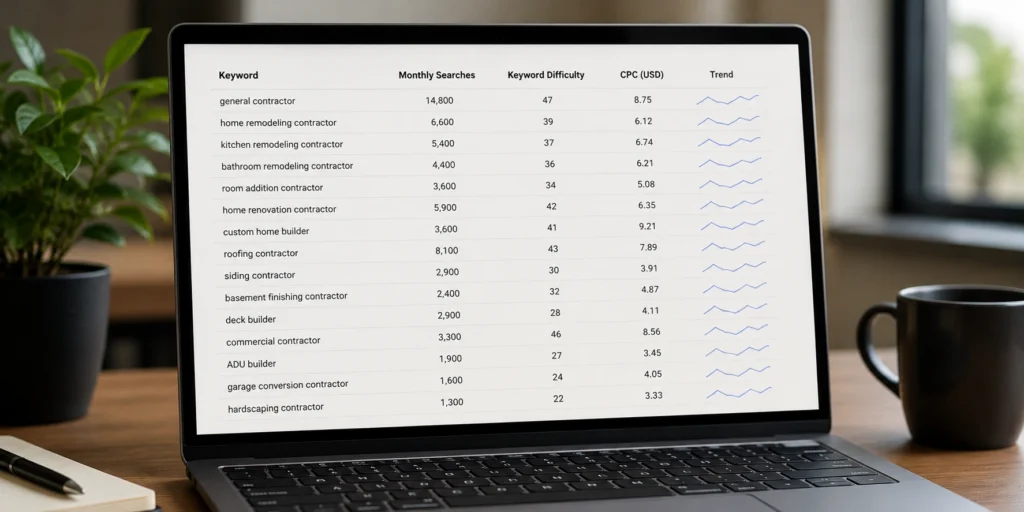
Competitor gap analysis fills in what’s left. Looking at which keywords a competitor ranks for that a given site doesn’t often surfaces entire categories of demand that were never considered, especially in adjacent service lines or nearby cities a business hasn’t actively targeted yet. This doesn’t mean copying a competitor’s content directly, but their ranking keywords are a reasonable proxy for what demand already exists and is provably searchable in a given market.
Matching Keywords to the Right Page
Not every keyword belongs on a service page. Informational keywords, the kind that show someone is still researching, generally belong in a blog post that builds trust and answers the question. Transactional keywords, the kind that show someone is ready to hire, belong on the service page itself, where a visitor can actually book. Contractor SEO audit strategy work often surfaces exactly this kind of mismatch: a service page stuffed with educational content and no clear path to booking, or a blog post accidentally competing with the service page it should be supporting instead.
This matters more than it might seem, because two pages targeting overlapping keywords can end up competing with each other in search results instead of reinforcing one another. A clear split, informational content living on the blog and pointing readers toward the relevant service page once they’re ready, keeps both working together rather than splitting the same ranking potential in half.
Things to Know
- “Near me” searches don’t require the literal words “near me” in your content. Google infers local intent automatically based on the searcher’s location.
- A keyword with lower search volume but clear buying intent usually outperforms a high-volume keyword that’s mostly researchers.
- Seasonal keywords should get content published 6 to 8 weeks before demand actually peaks, not once the season has already started.
- Commercial and procurement-related keywords, like RFP or tender language, signal a longer sales cycle but a significantly higher project value.
- Reviewing actual customer phone calls and past inquiries often surfaces better keyword phrases than any keyword research tool.
- A keyword strategy built once and never revisited goes stale. Search behavior shifts with trends, competitors, and even AI search adoption.
Frequently Asked Questions
What’s the difference between informational and transactional keywords for contractors?
Informational keywords come from people still researching, months from hiring, while transactional keywords come from people actively ready to book a contractor now.
Targeting the wrong type on the wrong page is a common mistake: a service page trying to answer a research question converts poorly, while a blog post chasing a transactional keyword rarely ranks against dedicated service pages.
Should contractors target high search volume keywords?
Not automatically. A lower-volume keyword with clear buying intent usually generates more actual jobs than a high-volume keyword full of researchers and DIYers.
Volume matters, but only after intent is confirmed. Checking what already ranks for a keyword is often a faster way to judge intent than looking at the volume number alone.
How do I find out what keywords my potential clients are actually searching?
Start with Google’s autocomplete and People Also Ask sections, then cross-check by reviewing actual customer calls and past inquiries for the exact language they use.
Real customer language often differs from industry terminology. A homeowner searching for help rarely uses the technical term a contractor would use for the same job.
Do “near me” searches need the exact phrase “near me” in the content?
No. Google automatically factors in a searcher’s location and shows local results, even when the content doesn’t literally include the words “near me.”
What matters more is clear service area information: city names, neighborhoods, and a complete Google Business Profile that confirms where the business actually operates.
How often should contractor keyword research be updated?
At least once or twice a year, and sooner if search trends, competitors, or service offerings change significantly.
A keyword list built once and never revisited misses shifts in how people search, including newer patterns shaped by AI-powered search results.
Building a Keyword List Worth Building a Strategy Around
Keyword research for contractors isn’t about finding the most searched terms. It’s about finding the terms that separate people who are ready to hire from people who are still browsing, then making sure each one lands on the right page.
SEO services for trade businesses at Construction Marketing Services build keyword strategy around real buyer intent, not vanity search volume, for contractors across these trades. If current content is getting traffic that never turns into calls, the keywords behind it are the first place to look.