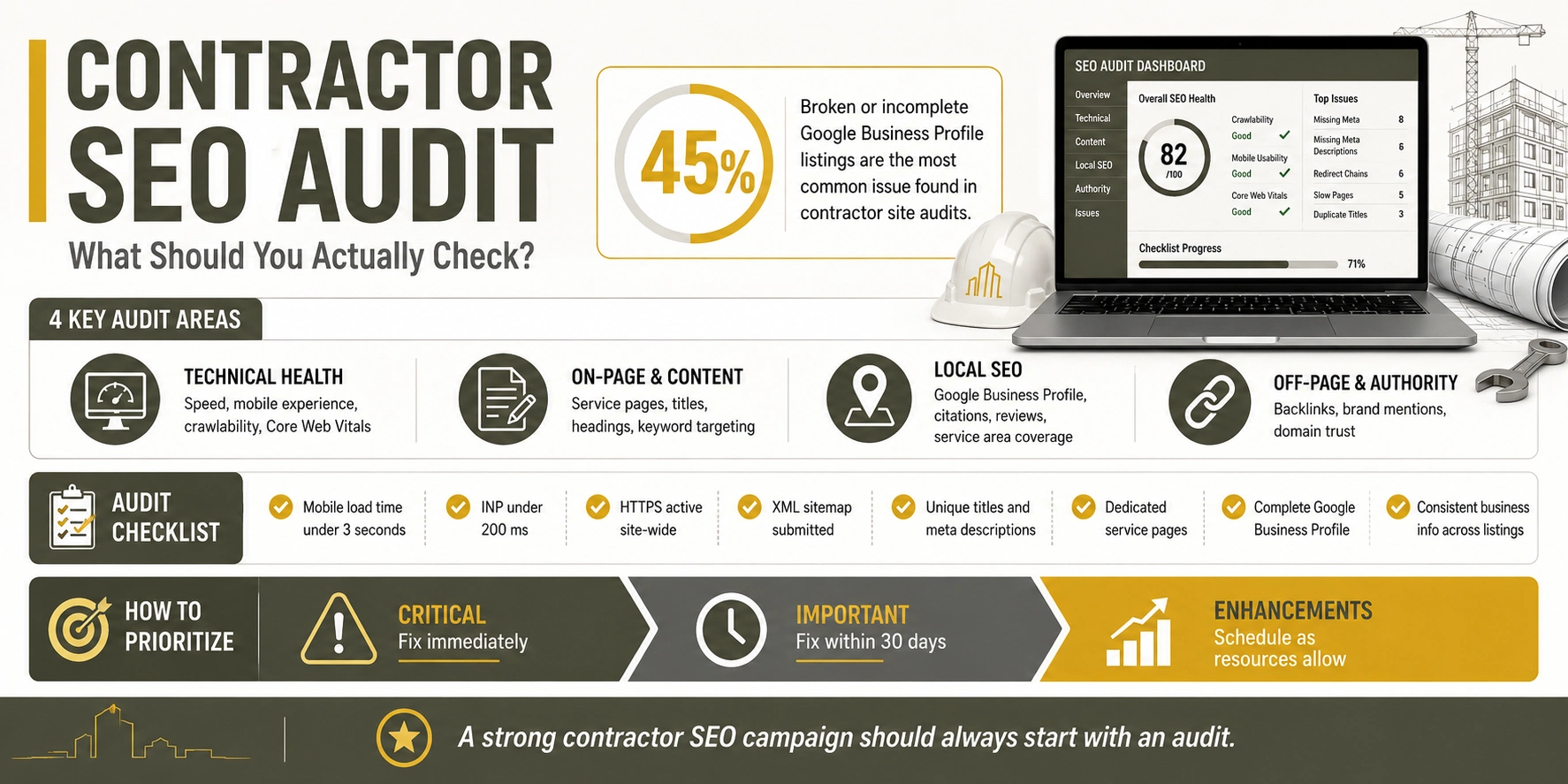
A contractor SEO audit is a structured review of a website across four areas: technical health, on-page optimization, local SEO signals, and content quality, done to find exactly what’s blocking better rankings before spending on more content or links. The most common single issue found across contractor sites is a broken or incomplete Google Business Profile listing, present in roughly 45 percent of sites audited, which is why an audit should never start with content and always start with the basics.
What follows is the checklist worth working through, area by area, along with how to prioritize whatever it turns up.
Key Takeaways
- A broken or incomplete Google Business Profile listing shows up in roughly 45 percent of contractor websites audited, making it the single most common issue found.
- A complete SEO audit checks four areas: technical health, on-page optimization, local SEO signals, and content quality.
- Each major service should have its own dedicated page. A single generic “Services” page can’t rank for multiple distinct services at once.
- Core Web Vitals now include Interaction to Next Paint, which should stay under 200 milliseconds for a healthy site.
- Audit findings should be prioritized by severity: critical issues fixed immediately, important issues within 30 days, and enhancements when resources allow.
- SEO isn’t a one-time project. Contractor websites should be re-audited quarterly, since competitors and search algorithms both keep changing.
For the fuller picture of contractor SEO overall, see our contractor search visibility guide. Professional contractor SEO work should always start with an audit like this one, since fixing the wrong things first wastes both time and budget.
Why a Contractor SEO Audit Comes Before Everything Else
Spending on content, links, or ads before auditing a site is like renovating a house with a cracked foundation. New content built on a slow, technically broken, or poorly structured site underperforms no matter how well it’s written, and the money spent producing it doesn’t go as far as it should.
This is also the most common reason an SEO investment feels like it isn’t working, even when the work itself is solid. A contractor publishing strong content on a site with a broken Google Business Profile, missing service pages, or slow load times is essentially building on sand. The content might be excellent, but it’s competing at a structural disadvantage that no amount of writing quality can fully offset.
Contractor SEO timeline strategy also depends on getting the audit right first. Foundational issues found and fixed early shorten the runway to real results, while the same issues discovered six months into a campaign mean redoing work that should have been caught at the start.
The Four Areas a Contractor SEO Audit Covers
A complete audit works through four distinct areas, and skipping any one of them leaves a real blind spot. Contractors often focus heavily on one area, usually content, while leaving the other three unchecked for years.
| Area | What It Checks | Why It Matters |
| Technical Health | Site speed, mobile experience, crawlability, Core Web Vitals | A technically broken site can’t rank no matter how good the content is |
| On-Page & Content | Service pages, titles, headings, keyword-to-page match | Determines whether the right pages target the right searches |
| Local SEO | Google Business Profile, citations, reviews, service area coverage | Most contractor searches carry local intent, and this is where most leads come from |
| Off-Page & Authority | Backlinks, brand mentions, domain trust | Signals to Google that other sites vouch for the business’s credibility |
These areas overlap in practice more than the table suggests. A slow site, a technical issue, also hurts conversion rate, which is a content and user experience problem. A missing service page is an on-page gap that also weakens local relevance for that specific service. Treating the four areas as connected rather than separate checklists produces a more accurate picture of what’s actually limiting a site.
Technical Health Checklist
Technical issues are worth checking first, since they can undermine every other improvement made afterward. A site failing on the items below won’t fully benefit from great content or a strong backlink profile until these are fixed.
- Site loads on mobile in under 3 seconds
- HTTPS is active site-wide, with no mixed content warnings
- Core Web Vitals pass, including Interaction to Next Paint under 200 milliseconds
- No broken links or redirect chains on key pages
- XML sitemap is current and submitted to Google Search Console
- Robots.txt isn’t accidentally blocking important pages
Most of these are quick to check and often quick to fix, which makes technical health one of the highest-leverage places to start any audit.
On-Page and Content Checklist
On-page issues determine whether the right pages are even positioned to rank for the right searches. A technically flawless site with poorly structured content still won’t rank for the terms that generate jobs.
- Every major service has its own dedicated page, not a shared generic page
- Title tags and meta descriptions are unique across all pages, with no duplicates
- Each page targets a clear primary keyword matching real search intent
- Heading structure follows a logical order, with one H1 per page
- Content demonstrates real expertise, not generic industry boilerplate
- Internal links connect related pages naturally throughout the site
A single generic “Services” page trying to cover five distinct trades or service lines is one of the most common on-page issues found, since it forces every service to compete for the same page’s ranking potential instead of each one having its own shot.
Local SEO Checklist
Local signals are where most contractor leads actually originate, which makes this section worth extra attention even though it often gets the least. A weak local presence undercuts strong technical and content work just as easily as a slow site does.
- Google Business Profile is claimed, verified, and fully completed
- Business name, address, and phone number match exactly across all listings
- Service area pages exist for each city or region actively targeted
- Review count and response rate are active and growing
- Local citations on major directories are accurate and current
- Location and service pages avoid duplicate or thin content

Prioritizing What You Find
Not every issue an audit turns up deserves the same urgency, and treating a 40-item list as equally important usually means nothing gets fixed at all. A simple three-tier framework works better: critical issues that actively block indexing or rankings get fixed immediately, important issues that represent clear missed opportunity get addressed within 30 days, and smaller enhancements get scheduled in when time and budget allow.
A missing Google Business Profile or a broken sitemap belongs in the critical tier, since these actively prevent visibility rather than just limiting it. A thin service page or a handful of duplicate meta descriptions belongs in the important tier, since they’re lost opportunity rather than active damage. Refining internal link anchor text across dozens of older blog posts is a reasonable enhancement, valuable but not urgent enough to delay fixing the first two tiers.
Contractor SEO pricing strategy decisions should reflect this same order. Fixing critical issues first often produces faster, more visible returns than spreading the same budget thin across everything the audit found at once.
Things to Know
- A missing or unverified Google Business Profile is often the single fastest fix with the most visible payoff of anything on an audit.
- An audit is a snapshot, not a one-time fix. Re-running it quarterly catches new issues before they’ve had months to cost leads.
- Self-audits are prone to blind spots, since the person maintaining a site often can’t see its own structural problems clearly.
- A technically clean site with no local signals still won’t show up for “near me” searches, and strong local signals can’t save a site that loads too slowly.
- Multi-location contractors need this checklist run per location, not just once for the whole site.
- An audit that produces a long, unprioritized list usually results in nothing getting fixed. Prioritization is what turns findings into an actual plan.
Frequently Asked Questions
What does a contractor SEO audit actually check?
A full audit checks four areas: technical health, on-page optimization and content, local SEO signals, and off-page authority like backlinks.
Skipping any one of these leaves blind spots. A technically perfect site with no local signals still won’t show up for “near me” searches, and strong local signals can’t save a site that’s too slow to load.
What’s the most common SEO problem found in contractor website audits?
A broken or incomplete Google Business Profile listing, found in roughly 45 percent of contractor websites audited.
It’s also one of the easiest fixes, which makes it a natural first stop in any audit. Claiming, verifying, and fully completing a Google Business Profile often produces some of the fastest visible improvement of anything on a checklist.
How often should a contractor’s website be re-audited?
Quarterly is a reasonable standard, since competitors, algorithms, and a business’s own service offerings all keep changing.
A one-time audit tells you where things stood on a single day. Repeating it regularly reveals whether fixes actually worked and catches new issues before they’ve had months to cost leads.
Should a contractor do their own SEO audit or hire someone?
A contractor can handle a meaningful chunk of a basic audit independently, especially the local SEO and Google Business Profile checks, but a full technical and content audit usually benefits from an outside, experienced set of eyes.
Self-audits are prone to missing issues that are invisible from the inside, since the person who built or maintains a site often can’t see its blind spots the way a fresh audit would.
What should happen after an SEO audit finds problems?
Findings should be prioritized by severity, critical issues fixed immediately, important ones within 30 days, and smaller enhancements as resources allow.
An audit that produces a long list with no priority order often results in nothing getting fixed at all, since the list feels too large to act on. Prioritization turns a checklist into an actual plan.
Turning a Checklist Into a Plan
A contractor SEO audit isn’t about generating a long list of problems. It’s about finding the handful of issues actually holding a website back, then fixing them in the order that produces results fastest. This checklist finishes what the rest of this cluster started: the pricing, timeline, and channel questions all assume the underlying site is actually in shape to compete, and an audit is how that assumption gets tested instead of taken on faith.
SEO audit services for contractors from Construction Marketing Services cover all four areas in this checklist, technical, on-page, local, and authority, with findings prioritized by what will actually move the needle first. If it’s been more than a quarter since the last real look at a website’s SEO health, that’s usually reason enough to run one.