Contractor SEO typically takes 3 to 6 months to show early movement and 6 to 12 months to produce steady, predictable lead flow. The first few months are mostly foundational work with little visible change, which is normal and not a sign something’s wrong. It’s how search engines build enough trust in a growing site to rank it consistently.
The businesses that understand this timeline going in stay the course long enough to see it pay off. The ones expecting results in month one usually quit right before the compounding starts.
Key Takeaways
- Most contractors see early SEO movement within 3 to 6 months and meaningful, steady lead flow between 6 and 12 months.
- Google’s own guidance puts realistic results at 4 to 12 months, depending on competition and how much work the site needs.
- The first 1 to 3 months are mostly foundational work, technical fixes and setup, with little visible ranking movement yet.
- Competitive trades like roofing and HVAC typically take longer to show results than less competitive trades in smaller markets.
- A site with years of technical debt or no prior SEO work needs more foundational time before rankings can move at all.
- SEO results compound rather than plateau. Month 12 results are typically stronger than month 6, not just more of the same pace.
For a broader look at how SEO for contractors works as a whole, see our contractor SEO fundamentals guide. This piece focuses specifically on timeline: what to expect, when, and why it takes as long as it does. SEO support for contractors built around realistic timelines starts with setting the right expectations before work even begins.
Why SEO Takes Months, Not Weeks
Contractors used to paid ads often expect SEO to work the same way: turn it on, see results immediately. SEO doesn’t work like that, and understanding why sets realistic expectations from day one.
How Search Engines Build Trust Over Time
Search engines don’t rank a new or recently changed site based on potential. They rank it based on demonstrated trust, built through consistent signals over time: content that stays live and gets referenced, backlinks that accumulate naturally, and user behavior that shows people find what they’re looking for. None of that happens in week one. A new service page might get indexed within days, but earning enough trust to consistently outrank established competitors takes months of those signals stacking up.
This is also why pausing and restarting SEO work is so costly. Trust built through consistent signals erodes when those signals stop, which means a six-month pause doesn’t just delay progress by six months, it often erases some of the ground already gained.
A useful comparison: think of a new contractor building a reputation in a neighborhood by word of mouth. The first referral doesn’t happen the day the business opens. It happens after enough completed jobs, enough satisfied customers, and enough time for that reputation to spread. Search engines evaluate a website in a similar way, just with different signals: content quality, technical health, and how other sites reference it, all accumulating before the algorithm is confident enough to rank the site consistently above competitors who’ve already earned that trust.
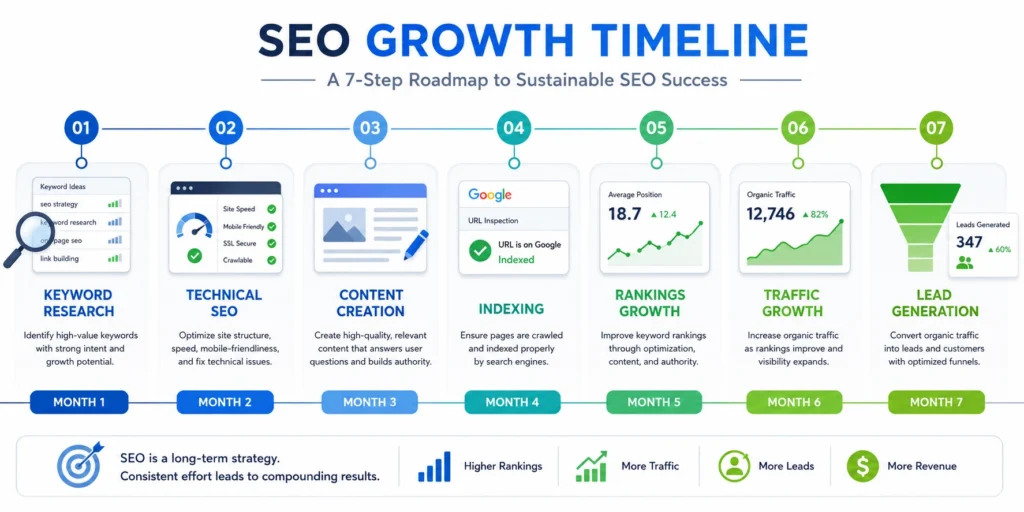
The Contractor SEO Timeline, Phase by Phase
Timelines vary by market and trade, but most contractor SEO campaigns move through the same four general phases.
| Phase | Timeframe | What’s Happening | What You’ll Typically See |
| Foundation | Months 1-3 | Technical fixes, on-page optimization, Google Business Profile setup, initial content | Little visible ranking change; some pages get indexed |
| Momentum | Months 3-6 | Content production ramps up, early backlinks build, local signals strengthen | First ranking movement; small increases in impressions and clicks |
| Traction | Months 6-9 | Rankings stabilize for target keywords, review count grows, local pack visibility improves | Noticeable increase in calls and form submissions |
| Compounding | Months 9-12+ | Content library matures, backlink profile deepens, brand searches increase | Steady, predictable lead flow that keeps building |
These phases overlap more than they’re sequential. Work from month one keeps paying off in month nine. The phases describe when results become visible, not when the underlying work actually happens.
What Speeds Up or Slows Down the Timeline
Trade and Market Competition
Roofing, HVAC, and plumbing tend to move slower than less competitive trades, since more established competitors are already occupying the top rankings for the same keywords. A contractor in a smaller market with less competition can often see meaningful movement faster than one in a dense metro area fighting twenty other businesses for the same searches.
Multi-location contractors face a variation on this same factor: each additional service area is effectively its own competitive landscape, with its own set of established competitors already ranking there. A business expanding into five new cities shouldn’t expect all five to move on the same timeline. Some markets will have less entrenched competition and show movement faster, while others will take the full range simply because of who’s already there.
Starting Website Condition
A site with clean technical health and some existing content has less ground to cover before rankings can move. A site with years of technical debt, thin or outdated pages, or no prior SEO work needs that foundational work done first, which pushes visible results further out even though the underlying effort started on day one.
Content Velocity and Consistency
How consistently new content and improvements get published matters nearly as much as the total volume. A contractor publishing one strong piece of content a week for six months typically outperforms one who publishes twelve pieces in a single month and then goes quiet, even though the total output looks similar on paper. Search engines respond to sustained activity, not bursts, since ongoing publication signals an active, maintained site rather than a one-time project.
SEO Timeline vs. Other Marketing Channels
SEO vs Google Ads strategy comes down largely to timeline. Google Ads can generate leads within days of launching a campaign, while SEO needs months to build the same trust signals organically. That difference is exactly why many contractors run both: ads cover the gap while SEO compounds in the background, and the balance shifts toward SEO as it matures and starts carrying more of the lead volume on its own.
Local Service Ads sit somewhere in between on setup time but still don’t compound the way SEO does. Once ad spend stops, whether Google Ads or Local Service Ads, lead flow from that channel stops too, immediately. SEO is the only channel among the three where month-24 results can meaningfully exceed month-12 results without a proportional increase in ongoing spend, since the content and links published early keep working long after they were created.

How to Know If Your SEO Is on Track
Rankings and traffic are the numbers most contractors watch first, but they’re not the only signal worth tracking, and sometimes not the most important one this early. Practical contractor keyword research done well at the start means the keywords being tracked are ones that actually generate jobs, not just ones that are easy to rank for. Impressions rising before clicks do, and clicks rising before calls do, is a normal early sequence, not a sign of stalled progress.
A campaign with genuinely zero movement across any of these numbers after 4 months, however, is worth a real conversation with whoever’s managing it. Some movement, even before leads pick up noticeably, is usually a good sign the underlying work is on track.
It also helps to separate visibility metrics from conversion metrics when judging progress. Rankings and impressions measure whether the site is becoming visible. Calls, form fills, and booked jobs measure whether that visibility is translating into business. Early on, expect movement in the first category well before the second, and don’t judge an SEO campaign’s health solely on lead volume in month two, when visibility itself is still being established.
Things to Know
- Ranking movement often shows up in Google Search Console weeks before it’s visible in a plain search, since impressions and average position shift before actual traffic does.
- A site migration or major redesign during an active SEO campaign can temporarily reset progress, so timing those changes matters as much as the changes themselves.
- Seasonal trades should expect timeline and demand to interact. Ranking well before a seasonal spike matters more than ranking well during the slow season.
- Consistency beats intensity. A steady monthly cadence of content and fixes outperforms a big initial push followed by silence.
- Local pack (map) rankings often move faster than organic rankings, since they weigh proximity and review signals more heavily than content depth.
- Pausing SEO doesn’t just stall progress, it can lose ground, since competitors who keep publishing and building links continue moving while a paused site stands still.
Frequently Asked Questions
How long does SEO take to work for a contractor?
Most contractors see early movement in 3 to 6 months and steady, predictable lead flow in 6 to 12 months.
That range shifts based on trade competitiveness and how much foundational work the website needs before rankings can move at all. Google’s own guidance puts realistic results in the 4 to 12 month range.
Why does SEO take so long compared to paid ads?
SEO has to earn trust through accumulated signals over time, while paid ads buy immediate visibility the moment a campaign launches.
That trade-off runs both directions. Ads stop working the moment spending stops, while SEO keeps generating leads long after the initial work is done, which is why the slower start is usually worth it.
What happens during the first 3 months of a new SEO campaign?
The first 3 months are mostly foundational: technical fixes, on-page optimization, Google Business Profile setup, and initial content, with little visible ranking change yet.
This phase is easy to mistake for a stalled campaign, but it’s the work that makes every later phase possible. Skipping it to chase faster visible results usually backfires.
Can a highly competitive market make SEO take longer?
Yes. Roofing, HVAC, and plumbing in dense metro areas typically take longer than less competitive trades or smaller markets, since established competitors already hold the top rankings.
A smaller market with less competition can sometimes see meaningful movement faster, even with a smaller monthly investment, simply because there’s less entrenched competition to outrank.
How do I know if my contractor SEO campaign is actually working?
Look for impressions and average position improving before clicks and calls do. That sequence is normal, not a sign of stalled progress.
A campaign with genuinely zero movement across rankings, impressions, and traffic after 4 months is worth a real conversation with whoever’s managing it. Some movement, even before leads pick up, is a good sign the work is on track.
Judging Progress by the Right Signals
There’s no way to make contractor SEO work in weeks instead of months, but there is a way to know whether it’s on track: watch the sequence of signals, not just the final number, and give the foundational work enough time to compound before judging results.
Construction Marketing Services sets realistic timelines with every contractor client from day one, since a client who understands the phases stays the course long enough to see the results actually land. If a current SEO effort feels stalled, the right first question is which phase it’s actually in, not whether it’s working at all.