Contractors lose leads when their homepage and service pages are not built for different user intents. The homepage should build brand trust, while service pages should answer specific needs, show proof, and drive action.
Key takeaways:
- Homepages support brand discovery and general credibility
- Service pages drive specific, high-intent lead conversions
- Generic homepages can dilute service relevance
- Thin service pages fail to answer buyer questions
- Homepage and service page keyword overlap can cause confusion
- Direct-entry users need trust signals on every service page
- CTAs should match the urgency of each service
When contractors treat service pages as primary revenue drivers—not secondary website pages—they create clearer paths from search intent to calls, quotes, and booked jobs.
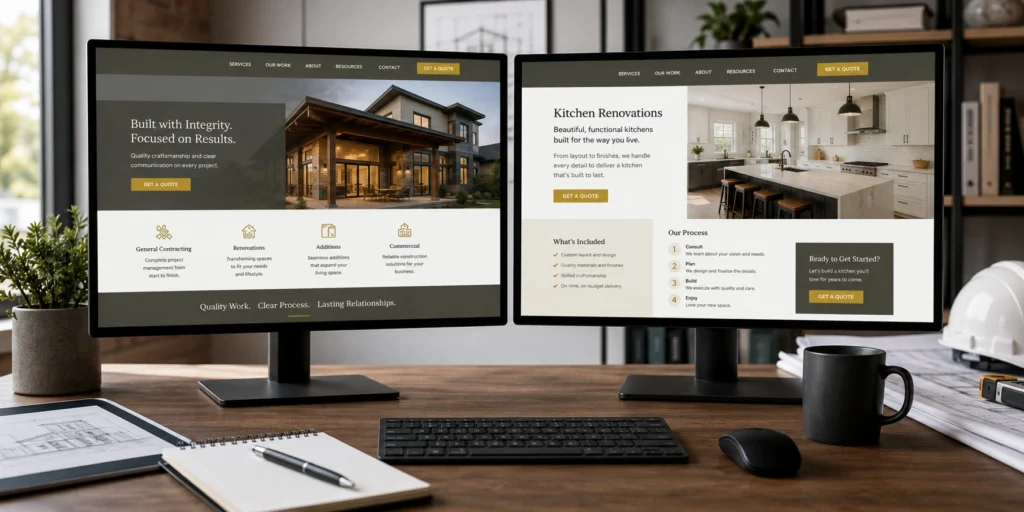
In the 2026 search environment, the way homeowners interact with your website has changed. Most contractors still treat their homepage as the front door of their business, assuming that every lead starts there and works their way in. However, data shows that high-intent searchers, those looking for a specific solution to an immediate problem, often bypass the homepage entirely. They land directly on a service-specific page via a search engine or an AI-answer result.
When your website structure does not account for this fragmented entry, you lose leads at an alarming rate. The homepage and the service page serve two fundamentally different purposes. The homepage is for brand discovery and general credibility, while the service page is for transaction and specific solutions. If these roles are blurred, or if your service pages are thin and neglected, you create a conversion gap that your competitors will gladly fill.
The Identity Crisis of the Generic Homepage
The primary role of your homepage is to answer the question: “Who are you and can I trust you?” It is where you showcase your overall company culture, your community involvement, and your broad range of expertise. However, a common mistake is trying to make the homepage do too much. When you cram every detail of your plumbing, HVAC, and electrical services onto one page, you dilute your authority.
A cluttered homepage confuses both the user and the search algorithm. If a user is looking for water heater replacement, and they land on a homepage that talks about everything from light fixtures to lawn care, they will perceive you as a jack-of-all-trades rather than a specialist. This lack of direct relevance is the leading cause of high bounce rates. To keep the lead, the homepage must act as a high-level switchboard that quickly routes users to the specific service page they actually need.
Why Service Pages are the Real Workhorses
For a contractor, the service page is where the actual sale happens. This is the page that must rank for specific, high-profit keywords like emergency pipe repair or commercial roof installation. In 2026, AI search models look for information gain on these pages. They want to see deep, technical details that prove you actually know how to perform the trade.
A common failure is having thin service pages that only contain a paragraph of text and a generic contact form. To convert a lead, a service page needs to include specific details about your process, the brands you use, your warranty information, and localized project examples. When you provide this level of granular authority, you satisfy the user’s need for information and the search engine’s need for expert content. This is how you win the click and the call.
The Danger of Cross-Contamination
One of the most frequent places contractors lose leads is through internal competition. This happens when your homepage and your service pages are fighting for the same keywords. If your homepage is optimized for “Plumber in [City]” and your plumbing service page is also optimized for the exact same term, Google may get confused about which page is more relevant.
This often results in the wrong page ranking for the query. If the homepage ranks for a specific service query, the user lands on a general page and has to go hunting for the information they actually wanted. Most homeowners will not do this work. They will simply click the back button. By using a strict service-silo architecture, you ensure that each page has a unique keyword signature. This creates a clear path for the user and prevents your own pages from cannibalizing each other’s traffic.
Optimizing for the Direct Entry User
Because so many leads land directly on a service page, that page must be able to stand alone as a complete trust environment. It cannot rely on the homepage to provide the company’s social proof. Each service page should have its own set of relevant reviews, its own industry-specific certifications, and its own clear call-to-action.
If a homeowner lands on your AC installation page and has to navigate back to the homepage to see your 5-star rating or your license number, you have created a friction point. In 2026, the thumb-friendly user expects all the necessary trust signals to be visible on the landing page. By duplicating your core trust elements across all service pages, you ensure that no matter where a lead enters your site, they are met with the evidence they need to hire you.
Call to Action Alignment
Another major leak in the conversion funnel is the misaligned call to action. The action you want a user to take on a homepage is often different from the action on a service page. On the homepage, a request a consultation button is appropriate. However, on an emergency-service page, that button should be a call now link with a direct connection to your dispatch team.
Your calls to action must match the urgency level of the service being offered. If someone is looking for a kitchen remodel, they are in a research phase and may prefer a digital quote form. If they are looking for burst pipe repair, they are in a crisis phase and need an immediate phone connection. When you tailor your contact methods to the specific intent of the service page, you significantly increase the lead-to-call ratio.
Conclusion
The battle for contractor leads is won by the firm that provides the most relevant experience at the exact moment of need. By understanding that your homepage is for who you are and your service pages are for what you do, you can eliminate the confusion that kills conversions. Stop treating your service pages as secondary afterthoughts and start treating them as the primary revenue drivers of your business. In 2026, the contractors who structure their websites with intent-alignment are the ones who will see their traffic turn into a consistent, profitable stream of service calls.