Local SEO ranking factors for contractors come down to three things Google officially names: relevance, distance, and prominence. Everything else, Google Business Profile completeness, reviews, citations, backlinks, feeds into one of those three categories. Google Business Profile signals alone account for roughly a third of the ranking weight, more than any other single category, which makes it the highest-leverage place to focus first.
Local SEO for contractors covers the broader strategy. This piece breaks down specifically what the algorithm weighs and by how much, so effort goes toward what actually moves rankings.
Key Takeaways
- Google officially names three core local ranking factors: relevance, distance, and prominence. Every other signal feeds into one of these three.
- Google Business Profile signals carry roughly 32 percent of local ranking weight, more than any other category.
- Primary category selection is the single most important individual ranking factor within the entire local algorithm.
- Review signals carry roughly 16 to 20 percent of ranking weight, and review recency matters nearly as much as review count.
- Distance can’t be directly changed, but its effective radius can be expanded through location pages and citations in each service area.
- Behavioral signals, like clicks, calls, and direction requests, are a growing but still smaller factor, carrying roughly 7 to 8 percent of ranking weight.
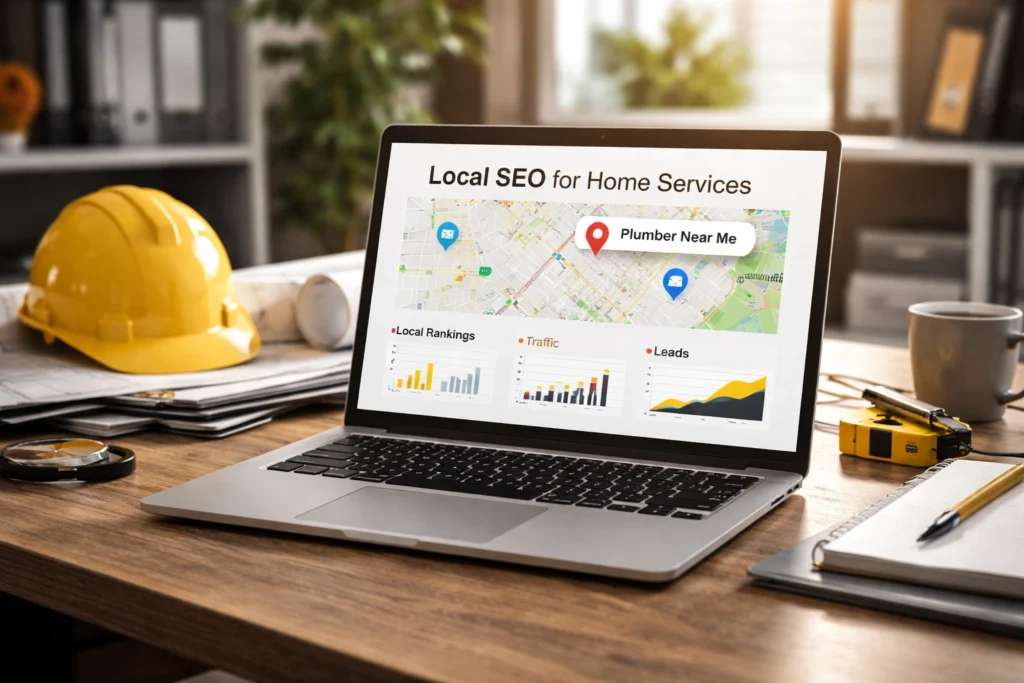
The Three Factors Google Actually Names
Google’s own documentation is direct about this: local results are based on relevance, distance, and prominence. Nearly every tactic in local SEO exists to influence one of these three.
Relevance
Relevance measures how well a business profile matches what someone is actually searching for. A plumber whose profile lists “24-hour emergency service” and uses the matching category signals stronger relevance for an urgent search than a generic “Plumbing Company” listing with no specifics.
Relevance isn’t limited to the category field either. Business description, services listed, attributes, and even the words used in recent posts and photo captions all feed into how well Google matches a profile to a given search. A profile that mentions “water heater installation” explicitly will surface for that search far more reliably than one that only says “plumbing services” and expects Google to infer the rest.
Distance
Distance measures how close a business is to the person searching, or to the city named in the query. It’s the one factor a business can’t directly change, though its effective reach can still be expanded through smart page structure. Google calculates this either from the searcher’s device location or, when a location is typed into the query, from that area’s approximate center point.
Prominence
Prominence measures how well-known and trusted a business appears, both online and in the real world. Review volume, backlinks, and overall digital footprint all feed prominence, which is why a well-reviewed business with strong citations can outrank a closer competitor with a weaker presence. A hardware store with 300 reviews and mentions from the local chamber of commerce will often beat a competitor located closer to the searcher but carrying almost no digital footprint at all.
How the Supporting Signals Actually Weigh In
Relevance, distance, and prominence are the official categories, but contractors need to know what actually feeds each one and how much it counts. Industry benchmarking breaks the practical signal weight down roughly like this.
| Signal Category | Approx. Weight | What It Includes |
| Google Business Profile | ~32% | Primary category, profile completeness, posts, photos, Q&A activity |
| Review Signals | ~16-20% | Review count, rating, recency, and response rate |
| On-Page Signals | ~15-19% | Location pages, service pages, schema markup, keyword relevance |
| Link Signals | ~15% | Local backlinks, citations, and directory listings |
| Behavioral Signals | ~7-8% | Clicks, calls, direction requests, and website visits |
These percentages shift slightly year to year and vary by source, but the order rarely does: Google Business Profile signals consistently outweigh every other category on this list. That’s a useful sanity check when deciding where to spend limited time or budget. A contractor debating between chasing more backlinks and fully optimizing their Google Business Profile should generally start with the profile, since it carries roughly double the weight of link signals on its own.
Why Primary Category Matters More Than Almost Anything Else
Of every individual signal inside the local algorithm, primary category selection carries more weight than any other single choice a contractor makes. A plumber whose profile is categorized simply as “Plumber” competes differently than one categorized as “Emergency Plumber Service” with drain and water heater work listed specifically, even when both businesses do the same work.
This is easy to underestimate because category selection feels like a small administrative detail buried in profile settings. In practice, it functions closer to choosing which race to enter, since a business only competes against others using overlapping categories for a given search. Getting it wrong doesn’t just mean missing out on a small ranking boost. It can mean competing in the wrong race entirely.
A quick way to check whether a category is actually optimized:
- Search the exact term being targeted and note which category the top-ranking competitors use
- Confirm the category matches the specific service, not just the general trade
- Add secondary categories for every distinct service actually offered
- Update the category immediately when a service line changes or expands
Distance Is Fixed, But Your Effective Reach Isn’t
A contractor can’t move their business address to sit closer to every searcher, but distance isn’t quite as fixed as it looks. Practical contractor service area pages become the main lever here, since a dedicated page for each city or neighborhood served, backed by matching citations in that area, expands where a business shows up as relevant, even though the literal proximity from the business address never changes.
Practical service pages vs location pages matters here too, since a location page built specifically for a city carries more local relevance than a single generic service area statement buried in an About page.
This distinction shows up clearly in practice. A roofing company covering five cities from one central office often ranks well in that home city but nearly invisible in the other four, simply because nothing on the site tells Google, or a searcher, that the company actually serves those areas. Building a genuine page for each city, with real content about that market rather than a copy-pasted template, closes most of that gap.

Where Contractors Usually Get This Wrong
A handful of mistakes show up repeatedly across contractor profiles, and most of them are quick to fix once identified. None of these require a large budget or a long project, just attention to details that tend to get set once and forgotten.
- Choosing a broad category like “General Contractor” instead of the most specific one that matches actual searches
- Letting review responses lapse for months at a time, even with a decent overall review count
- Serving five cities but only ever mentioning one of them anywhere on the website
- Hiding an address as a service area business without adjusting the related local settings, which can accidentally hurt relevance
- Ignoring behavioral signals entirely, so a listing with strong reviews still underperforms due to low click and call activity
Things to Know
- Roughly 74 percent of users specifically look for reviews from the last three months, which is why review recency carries real weight beyond just total count.
- A fully optimized Google Business Profile outranks an incomplete one in nearly every scenario, even when every other factor is roughly equal.
- AI answer engines increasingly pull local business data through the same Google Business Profile and Bing Places signals that feed traditional local search.
- Secondary categories add relevance for additional services without diluting the primary category’s strength.
- A single strong local ranking factor rarely compensates for a weak one elsewhere. The signals work together, not independently.
- Ranking factor weightings shift over time as Google updates its algorithm, so a strategy built once and never revisited eventually falls behind.
Frequently Asked Questions
What are the most important local SEO ranking factors?
Google names three core factors: relevance, distance, and prominence. Every other ranking signal, Google Business Profile strength, reviews, citations, backlinks, feeds into one of these three.
Google Business Profile signals carry the most individual weight of any category, at roughly a third of the total algorithm, which is why it’s usually the highest-leverage place to start.
What’s the single most important local ranking factor?
Primary category selection on a Google Business Profile is widely considered the single most influential individual signal in the entire local algorithm.
A category that precisely matches what’s being searched, rather than a broad, general one, gives a meaningful relevance advantage over competitors using vaguer categories.
Can a contractor improve their distance ranking factor?
Not directly. Distance is based on the searcher’s actual location, but a business can expand its effective reach through dedicated location pages and citations in each area served.
This is why service area businesses covering multiple cities benefit from building out individual pages for each one instead of relying on a single generic service area statement.
How much do reviews affect local rankings?
Review signals carry roughly 16 to 20 percent of local ranking weight, and recency matters nearly as much as total count.
A steady, ongoing pace of new reviews tends to outperform a large batch collected once and then left untouched, since recent reviews signal an active, currently operating business.
Do behavioral signals like clicks and calls actually affect rankings?
Yes, though they carry less weight than Google Business Profile, reviews, or on-page signals, at roughly 7 to 8 percent of the total.
A listing with strong reviews and a complete profile can still underperform if almost nobody clicks, calls, or requests directions from it, since Google reads low engagement as a weaker signal of real-world relevance.
Focusing Effort Where the Weight Actually Is
Local SEO ranking factors aren’t a mystery or a moving target the way some advice makes them sound. They come down to three things Google names directly, and a fairly well understood set of signals that feed into each one.
Construction SEO support from contractor local search specialists at Construction Marketing Services prioritizes these signals in the order they actually carry weight, starting with Google Business Profile and category accuracy before spreading effort across lower-impact tactics. Getting the order right is often the difference between months of scattered effort and a local ranking that actually moves.