
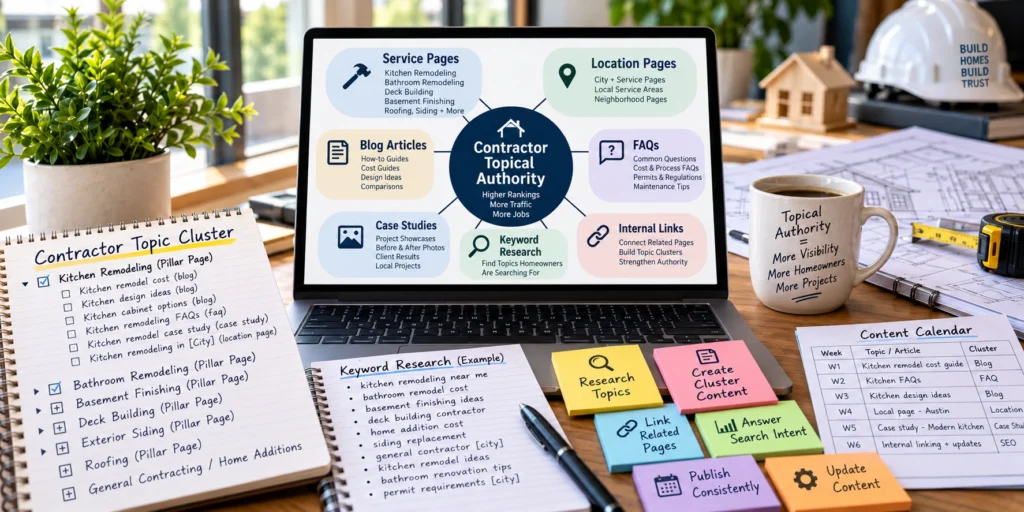
Topical authority for a contractor website comes from covering one trade or service thoroughly: a strong service page at the center, supported by content that answers every question a buyer asks before hiring, all connected with internal links. Search engines and AI answer tools then treat the site as a reliable source on that topic, which helps its pages rank for more searches than any single article could.
Key Takeaways
- Topical authority means covering a service area completely, not just publishing more posts.
- Start with one service hub and build supporting content around real buyer questions.
- Assign every topic to a page type so posts and service pages do not compete.
- Project photos and case studies supply experience that competitors cannot copy.
- Internal links between the hub and supporting pages show how topics connect.
- Measure by topic group in Search Console, and expect gains over months, not weeks.
What Topical Authority Means for a Contractor
Topical authority is the idea that a website that covers a subject in depth tends to rank for more searches about it than a site that mentions the subject once. For a contractor, the subject is usually a trade or a service, such as roof replacement, kitchen remodeling, or panel upgrades. A site that explains the costs, the process, the materials, the common problems, and the local conditions around that service looks like a dependable source. A site with one short service page and nothing around it does not.
Search engines do not publish a topical authority score, so this is an outcome to build toward rather than a setting to switch on. It also does not replace the basics. Strong service pages, a clear site structure, and a healthy Google Business Profile all still matter, and the broader construction contractor SEO guide explains how these pieces fit together.
Pick One Core Topic First
The most common mistake is trying to build authority on everything at once. A contractor who offers six services and publishes one thin article on each ends up with six shallow topics instead of one strong one. A better approach is to choose the single service that matters most, usually the one with the best margins, the strongest demand, or the best project portfolio, and build it out completely before moving on.
- List your services and rank them by profit, demand, and how much proof you have.
- Choose the top one and treat it as the first topic to own.
- Write down the main pages that topic needs, starting with the service page itself.
- Build the supporting content, then move to the next service once the first is complete.
This keeps effort focused, and it makes results easier to measure because there is a clear group of pages to watch.
Map the Questions Buyers Actually Ask
Supporting content works when it answers real questions, so the research should start with real conversations. The people who call for estimates, fill out contact forms, and leave reviews are already telling you what the market wants to know. Keyword tools help size the demand, but they work best as a second step, once the real questions are on the table.
- Questions customers ask on estimate calls and site visits.
- Wording that appears in contact form messages and reviews.
- Google autocomplete and People Also Ask results for the service.
- Queries already showing up in Search Console for the service page.
- Topics that competitors cover which your site does not.
Group the questions by buyer stage. Early questions, such as signs a roof needs replacing, attract people who are just starting to research. Middle questions, such as costs and materials, attract people comparing options. Late questions, such as what happens on installation day, attract people close to hiring.
Assign Each Topic to the Right Page Type
Not every topic belongs on a blog post, and not every keyword belongs on a service page. A research question such as how much a roof costs fits an article, while a search such as roof replacement near me belongs on a service or location page. Putting a topic on the wrong page type, or covering the same keyword on two pages, makes pages compete with each other instead of supporting each other. The decision is covered in more detail in the breakdown of blog vs service page keywords, and it is worth settling before any writing starts.
A simple check helps. Before writing anything new, search your own site for the topic. If a page already covers it, improve that page. If two pages overlap, decide which one owns the keyword and adjust the other. Authority comes from a clear structure, and duplicate coverage blurs it.
Build the Hub and Supporting Content
A topic cluster has a hub, which is usually the service page, and supporting pages that each cover one question or angle. Every supporting page links to the hub, and the hub links out to them. Consistent publishing is what makes this work, which is why many contractors rely on contractor blog writing services to keep the supporting content moving without pulling crews or office staff away from the work.
The table below shows what a cluster might look like for a roofing company building authority on roof replacement. The same pattern works for any trade, with the examples changed to fit.
| Content Piece | Roofing Example | Buyer Stage | Links To |
| Service hub | Roof Replacement in [City] | Ready to hire | Every supporting page below |
| Cost guide | How much does a roof replacement cost? | Researching | The service hub |
| Comparison | Asphalt shingles vs metal roofing | Comparing options | The service hub and cost guide |
| Process | What happens on roof replacement day | Evaluating contractors | The service hub |
| Problem | Signs your roof needs replacing, not repair | Early research | The service hub and repair page |
| Proof | Roof replacement case study with project photos | Deciding | The service hub |
| Local page | Roof Replacement in [Neighborhood] | Ready to hire | The service hub |
Use Real Work as the Authority Layer
Experience is the part of authority that competitors cannot copy. A contractor who has completed hundreds of jobs has photos, details, and lessons that no generic article can match. Turning that material into content is one of the strongest moves available. A detailed contractor case study SEO approach shows what was done, why, and what the result was, and it gives the hub page real proof to link to.
Smaller wins matter too. Finished jobs can become project pages with photos, materials, and location details, which is the idea behind treating contractor project SEO assets as part of the cluster instead of leaving them in a gallery. Each one adds specific, believable detail that supports the main service page.
Keep the Content Helpful and Current
Depth only helps if the content is useful. Pages that repeat what every other contractor says, or that exist only to add a keyword, tend to dilute a site instead of strengthening it. The test is whether a homeowner would learn something from the page, which is the standard behind helpful contractor content: specific answers, honest limits, and real examples.
Topics also age. Prices change, codes update, and materials improve, so a cluster needs maintenance. A regular review of older pages, guided by a clear contractor content refresh strategy, keeps the hub and supporting pages accurate and signals that the site is actively maintained.
Connect Everything With Internal Links
Internal links are how a cluster becomes a structure instead of a pile of pages. Each supporting page should link to the hub using descriptive anchor text, and the hub should link to each supporting page. Where two supporting pages are closely related, such as a cost guide and a materials comparison, a link between them helps readers and search engines follow the topic.
Keep the links natural. A link belongs where a reader would want the next step, not wherever a keyword happens to appear. When a new supporting page goes live, update the hub the same day so the connection is in place from the start.

Measure Progress by Topic Group
Authority builds gradually, so measurement should focus on the group of pages rather than any single article. In Google Search Console, filter by the pages in the cluster and watch impressions, the number of queries the group appears for, and average position over time. Rising impressions across many related queries are the earliest sign that the cluster is working, usually well before a jump in leads.
Expect the process to take months. New pages need to be crawled and indexed, and rankings tend to shift in stages as links and content accumulate. If a supporting page earns no impressions after a reasonable period, check whether it duplicates another page or answers a question nobody is asking, and then improve it or fold it into a stronger page.
Things to Know
- Search engines do not publish a topical authority score, so any score a tool shows is an estimate.
- Many thin posts rarely build authority, because depth on one topic beats volume across many.
- Every supporting page should link to its hub, and the hub should link back.
- Sales calls and estimate requests are often better topic sources than keyword tools alone.
- Search your own site before writing a new page, to avoid competing with an existing one.
- Update the hub whenever a supporting page is added, so the links never lag behind.
Frequently Asked Questions
What is topical authority in SEO?
Topical authority is how thoroughly and reliably a website covers a subject, which helps its pages rank for a wider set of related searches.
Search engines do not publish a topical authority score, so it is best understood as an outcome rather than a setting. A contractor site that answers every major question about a service, and links those answers together, gives search engines and AI tools a clear reason to treat it as a reliable source.
How many articles does a contractor need to build topical authority?
There is no fixed number. Cover the questions buyers actually ask about one service before moving to the next.
A practical starting point is a service hub and roughly six to ten supporting pages, then expanding based on what Search Console shows. Depth on one service usually does more than a thin post on every service.
How long does it take to build topical authority?
Expect months, not weeks, since new content needs time to be crawled, indexed, and linked before it ranks.
Timelines vary with competition, the age of the site, and how consistently content is published. Tracking impressions and rankings for the topic group each month shows progress long before leads increase.
Do blog posts or service pages build topical authority?
Both do. Service pages hold the buying intent, and blog posts cover the research questions that lead there.
Neither works well alone. A service page with no supporting content looks thin, and a library of posts with no strong service page to point to gives readers nowhere to go once they are ready to hire.
Can a small contractor compete with larger companies on topical authority?
Yes, by going deep on a few services and local topics instead of trying to cover everything.
Larger competitors often publish broadly but shallowly. A smaller contractor with real project photos, local knowledge, and detailed answers on its best services can stand out for the searches that matter most.
Building Authority One Topic at a Time
Topical authority is built the way a good contractor builds a reputation: one job done thoroughly, then the next. Choosing a single service, answering the questions buyers really ask, backing it up with real project work, and connecting everything with clear links gives a website a durable advantage that a handful of scattered posts cannot match. Start with the service that matters most, and let each finished topic make the next one easier.


